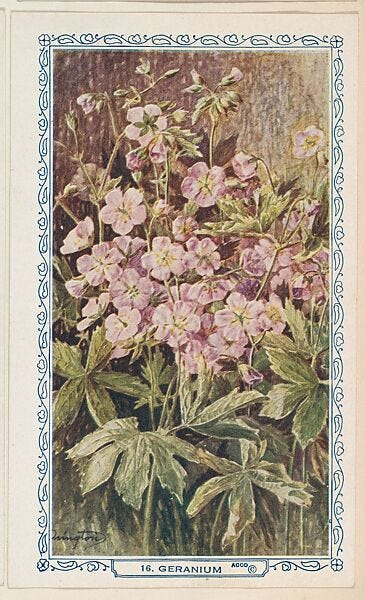
That's Wild Geranium!
Keep humming

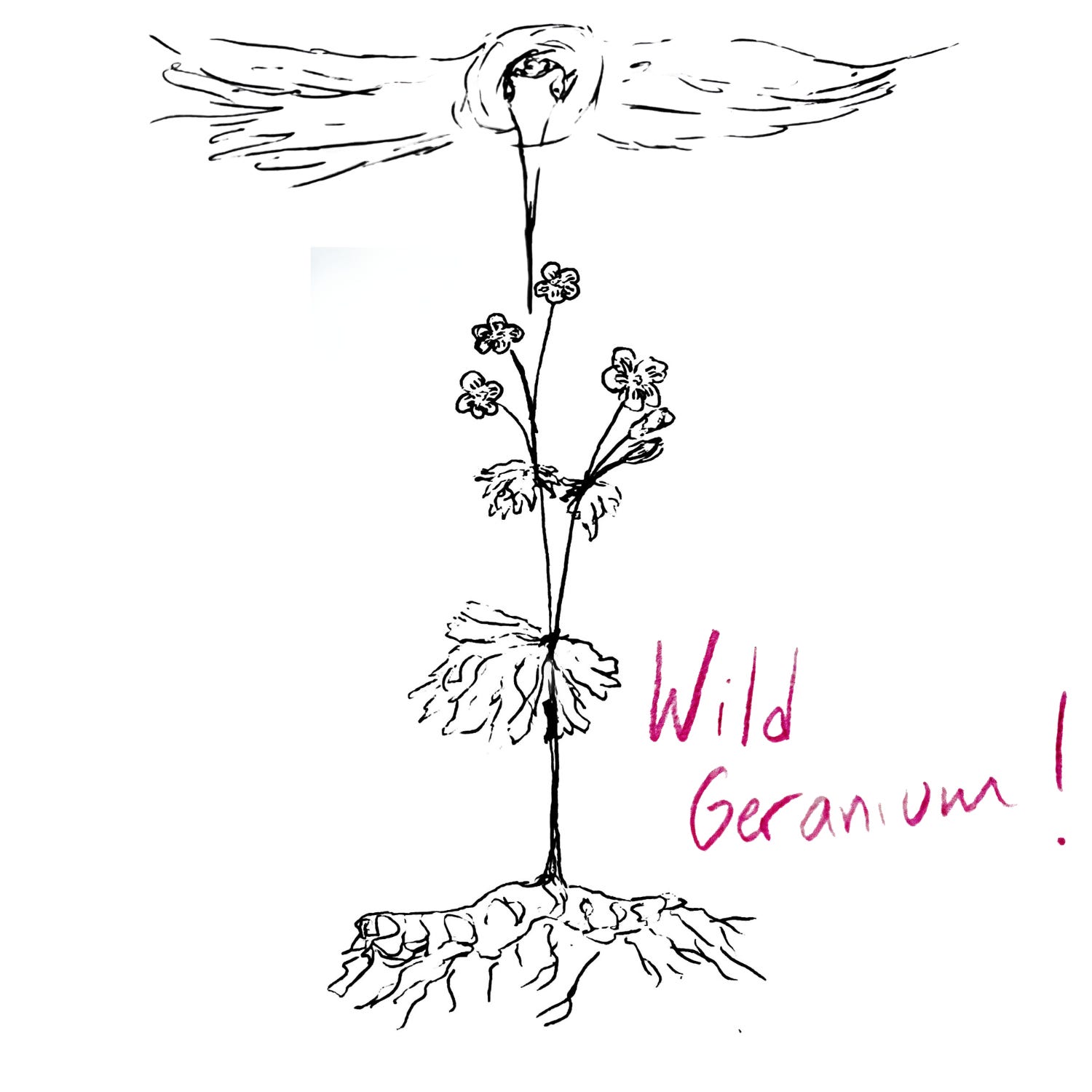
ALSO KNOWN AS: cranes bill, alumroot, Geranium maculatum
The world moves around the stage of civilization like water around rocks. Caught up in technology or the structure of work it’s easy to lose the land, the seasons, the wildlife. We forget real life is interwoven with the patterns of the wilderness. I heard mourning doves before I knew them - decades before I knew them. The sound forever reminded me of weekends visiting my grandfather. The smell of herring on my fingers. The symphonies his cracking voice sketched the breadth of. I knew he could hear it fully in his mind. I don’t know the names of the pieces. I only know his voice. And mourning doves and their down, up, coo, coo, coo, like a prayer.
Arrive in a Dream
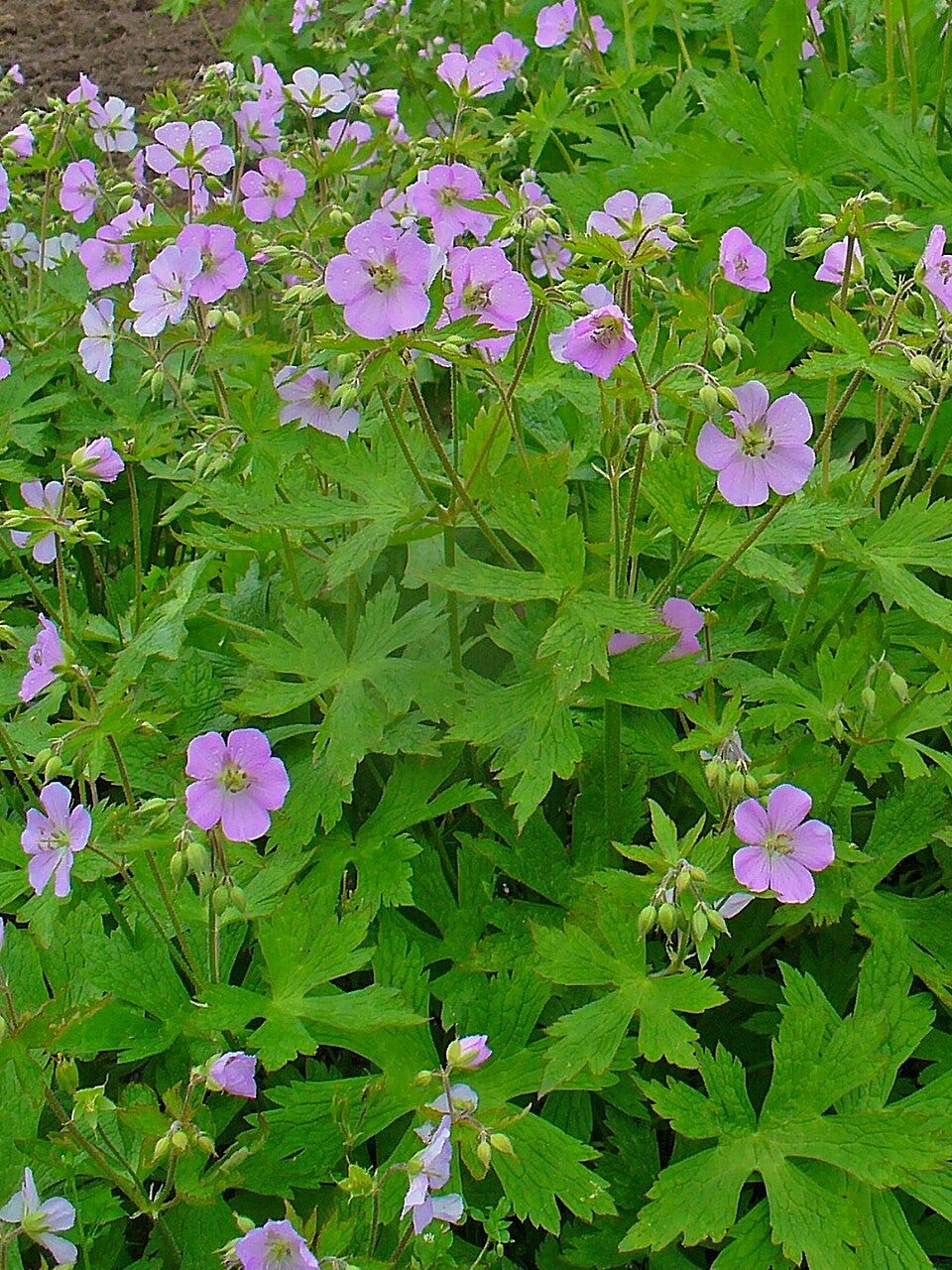
The world calls to us if we listen. Like the time a plant called to me in Prospect Park ten years ago. I felt the same way about geranium as I felt about carnation: a gaudy houseplant no one looks at. These are the ones that grow bright and are highly cultivated on lawns with rough frilly leaves that look like an old tule skirt. The well known houseplant is from South Africa and not in the Geranium family at all. There are 400 geranium species that grow all over the northern hemisphere. But the geranium in the Brooklyn wood was wild and the petals glowed luminescent beneath the shadow of a tree. It was so delicate it seemed to be made of a dream. The vision was shocking, though the plant itself was no more than a whisper. Crane bill is what they are commonly named. Geranos means “crane” in Greek. Their leaves are prominent around a neck so narrow it disappears at certain angles.
The Geranium maculatum grows from Maine to Minnesota where the forests drop away and geranium watches the long grasses cover the world. It grows as far south as a long winter freeze will reach.
Five palmately lobed leaves open out like hands. Hard working hands. Hands tend to look like leaves, as if the leaf was the first to know what it meant to hold. They’re textured with deep veins and a layer of hair. From the base of the petiole of the leaf emerges a mystery. Taxonomists are fascinated by the way the stems rise up - is it in a corymb or a cyme? They wonder as the flowers seem to form a lower case Y shape with one side shorter than the first. Think of the arrangement of flowers like a chandelier: however flowers rise up along the stems, these inflorescences have names. One might look like a ball, or one a wand. One might simply be a disc and there you have a sunflower. The going rule states wild geranium must be a cyme because the flowers appear in a progressive shape, like a spiral.
The leaves yellow with too much sun. And the flowers? They won’t bloom unless sun shines on them. It’s a balance.
Knotting in the soil it will create a rhizome link that can be broken and replanted. The rhizomes have pale white tips that are the following year’s buds. For a young plant those buds won’t develop until the plant is two or three years old.
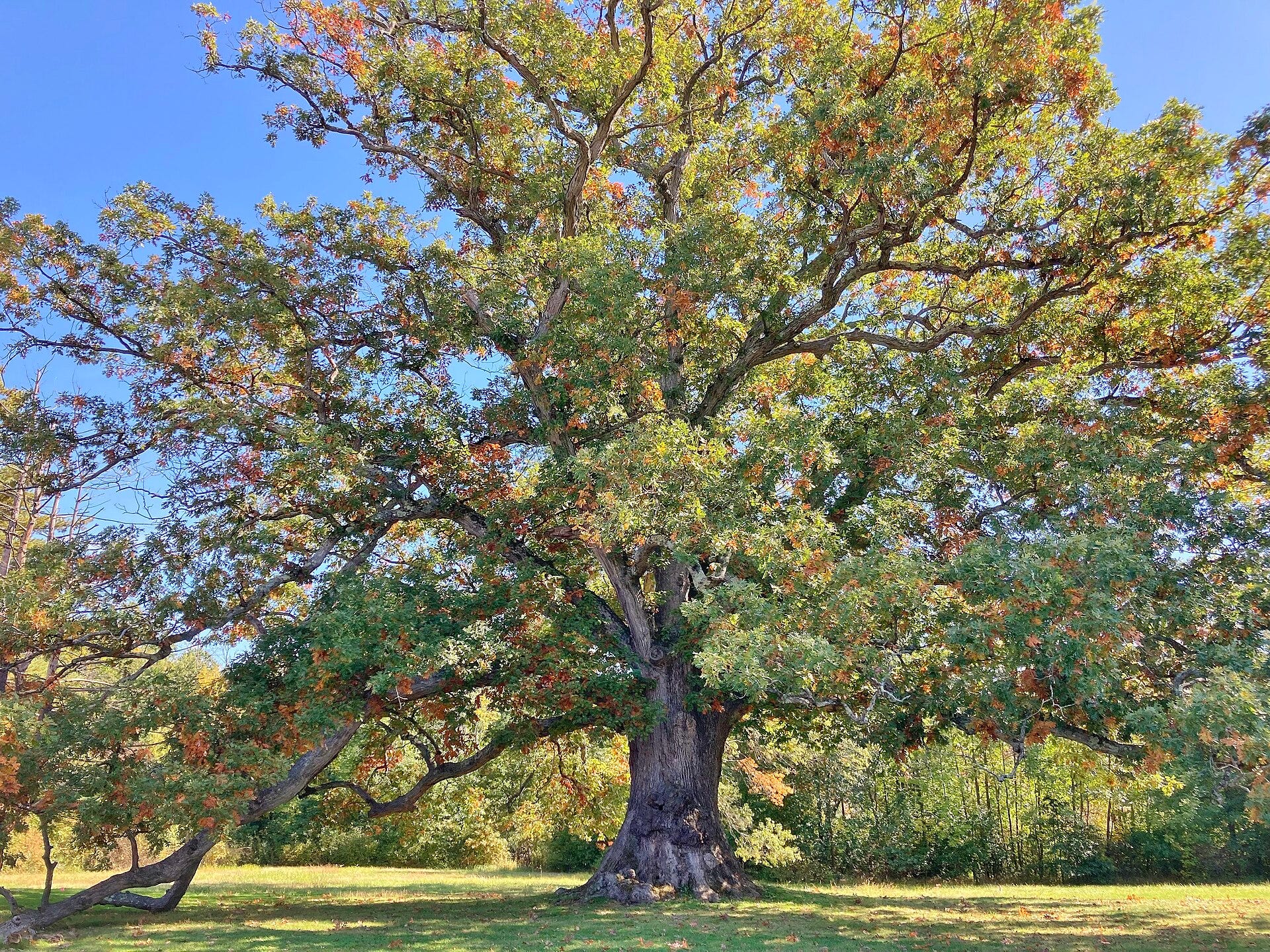
Wet soils, or poor soils, wild geranium grows in the middle of the forest where trees have fallen making a tear in the over story. Their narrow roots live a long time, though they’re only a few inches below the soil. They just keep living and sending up shoots as long as the soil is healthy. What I mean is that I haven’t found a number for how old they can get - decades at least. Part of their eternal youth is the mycorrhizal connections that branch from their roots and nourish them with nutrients and minerals. Thus wild geranium grows in stands upheld by their underground stems. Yet, while they are adaptable, they are not an aggressive species. They keep to their spaces whether that be a stream bed, the edge of a forest, or even a roadside. As it is with the wild, they have close companionships. Wild geraniums tend to congregate around the bases of oaks, specifically white oak trees where the soil is enriched with calcium delivered from runoff down the trunk of the tree.
A Moment in Time
Once bloomed the plant reveals flowers that are shallow cups or, at times, faces directed horizontally, with five petals that have several dark rays in the form of halos around the pistil. Pink, even lightly magenta, cups. The color appears to light them up from within, yet they are nearly transparent, made of something only slightly denser than air. While usually bisexual, geranium will occasionally be only female. And if this is the case, the female will produce scores more seeds than a bisexual plant. When there are several female plants in an otherwise bisexual species this is called gynodioecy, meaning that likely the plant is evolving to have male and female plants, like holly and cloudberry, and we are witnessing the middle of its millennial shift. Whether this is true or not, plants are not rule followers.
Flies, bees, and beetles pollinate wild geranium. However, the specialist pollinator is a mining bee called the distant miner bee.
Once the seeds mature they’ll lay in dark pillows until they are ready to explode out. At the end of summer the pressure of their seed pods slingshots seeds which land between 10 and 30 feet away from the parent plant. What is left leaves the plant looking much like an art deco design with four curled seedpods with rounded ends hanging spritely on a banner. Sparrows, and the mourning dove, whose song covers the world at the time of their blooming as they nest, forage their seeds.
Because a geranium plant won’t bloom unless there’s sun shining down on it waits, making leaves every year and sustaining its roots until a storm comes through and makes a tear in the forest canopy, letting all that light in. The seeds remain in the soil for certainly over 400 days as the cold sets in. The longer the seeds have cold, the higher the germination rate. They, like many of the plants in places that have winter, need stratification.
Medicinally, wild geranium is generally a medicine rather than a food. Because of its high astringency, it can cause cramping or constipation depending on how much a person eats. So as a food it is used more as an herb used for flavor. For tribes throughout the midwest and northeast, it has been used as a dental aid and an important remedy to treat gastrointestinal issues. It also has been used to treat venereal disease. According to J.T. Garrett in his book The Cherokee Herbal: Plant Medicine from the Four Directions, wild geranium belongs to the direction of the south and provides protection in a literal sense. Their rhizomes have tannins which make it an effective wound healing plant as it promotes cell growth.
I was the slightest in the house-
I took the smallest room-
At night, my little lamp, the book-
And one Geranium-…-Emily Dickinson
Far away from my grandfather’s voice, I stood in the tiny Paris bathroom of the tiny Paris apartment where my life wreathed me in a mess. My heart had been beating too hard for weeks. Panic is simple, common, and ruthless. I washed my hands with nothing in my head but the obsession with my own existence. I felt I was holding myself together with nothing but the selfish bandages of thought. The incessant gaze of my own running mind made me ill. I had been alone for days and in that moment found the fringes of a song, whose notes I hummed. It was barely enough.
Geranium is one that hovers between the worlds, soft and narrow as it is. And yet it tends to tears, scratches, and cuts. Whether the scratch be on a vulnerable forest floor, or our own skin. We are full of preciousness, it seems to say, glowing from within. Ephemeral as humans are, we are worth holding together with soft hands.
myth for wild geranium
Text for myth, Music: Track 1-12: From The Four Seasons by Antonio Vivaldi
Live, Unedited performance, Wiedemann Recital Hall, Wichita State University, John Harrison – Violin | Robert Turizziani – Conductor, The Wichita State University Chamber Players https://johnharrison.cc Permission for publication by: John Harrison License Terms: CC BY-SA 4.0
Forager Friendly?
For experienced foragers only.
Sources:
https://www.fs.usda.gov/database/feis/plants/forb/germac/all.html
https://pmc.ncbi.nlm.nih.gov/articles/PMC10873751/
https://journals.ashs.org/view/journals/hortsci/29/8/article-p865.xml
https://mdc.mo.gov/discover-nature/field-guide/wild-geranium-cranes-bill
https://cornellbotanicgardens.org/plant/wild-geranium
https://research.fs.usda.gov/feis/species-reviews/germac
https://www.nature.com/articles/hdy201448
The Cherokee Herbal: Plant Medicine from the Four Directions, J.T. Garrett
https://www.dnr.state.mn.us/pollinators/andrena-distans-distant-miner-bee.html
http://naeb.brit.org/uses/search/?string=Geranium+maculatum+