
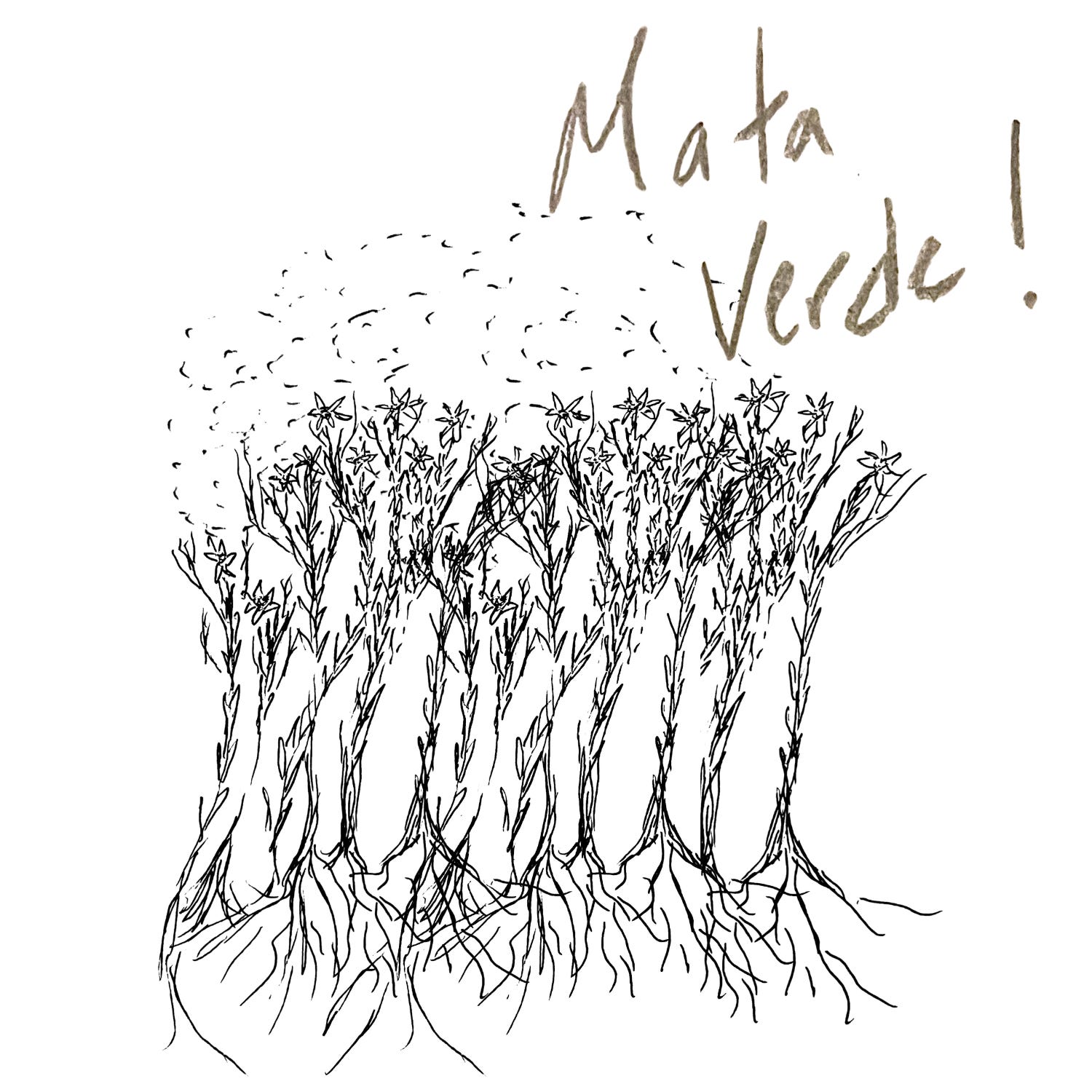
That's Mata Verde!
A cloud to make you see

ALSO KNOWN AS: Mata Negra, Ko’or, fascine, fachine, Chiliotrichum diffusum
Solitude is only ever a matter of perspective. Three hundred miles off the Eastern coast of Patagonia lie 200 islands, the largest of which are the Eastern and Western Falkland Islands. On these islands a dog species lived for some time. Maybe ten thousand years. When Darwin traveled there it was believed to be the only mammal on the islands. It looked a bit like a fox, but it was an ancient wolf. More specifically, it was a memory of people who once lived there - the Yaghan people who brought their dogs. The Falkland fox was hunted into extinction in the late 1800s. Now the islands are for the seals and the birds, the insects, and the roving exotic sheep, all overseen by a bitter herb that remembers it all. The mata verde.
In fuzzy shrouds over the Falkland islands and Tierra del Fuego where the southernmost part of the world is in Patagonia - rolling off the Andes the land dries as it make its way to the east: a steppe that hovers like a table of earth at 5,000 feet, mata verde punctuates this entire expanse.
The steppe does something to time: lengthening it. You can see a brush fire twenty miles to the right and a storm twenty miles to the left. It is a palace where time becomes long, where shelter is a cloud.
And What Would You Do if You Saw Rhinos in Patagonia?
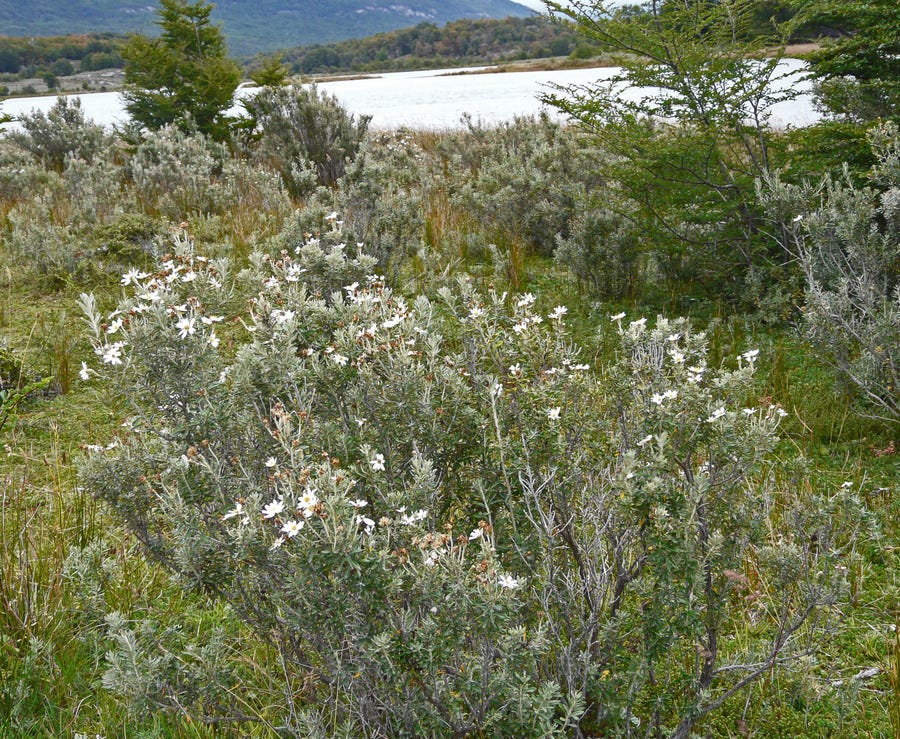
White terminal flowers crown the many stems of mata verde, with lanceolate leaves like rosemary reach up. At one time this was one of the most common shrubs in the Falkland islands. It is aggressive - abundant - exuberant. But now it is very uncommon because livestock love it. Now it only grows in the riparian areas and canyons that can’t easily be reached by hoofed feet. Other than that the plant is not worried by much. It grows in soil that is sand or clay. It grows in places packed and tousled by wind. It can grow with salt on the breeze.
The foliage is aromatic, oily, like its cousin, sage. But it’s different - of course. This place is brittle with cold.
Cuttings will sprout new roots, as if it could walk, one root and then another root, like steps of a slow beast. The plant borrows from animals to survive. Chiliotrichum diffiusum is its official name. Diffusum refers to the way its branches separate out like wired hair. For this plant, protection looks like rhinoceros, or bear skin. The trichomes on their leaves could be brushed, and their woody branches keep their fluids protected. It’s easy to not see plants in a world of wind. They stand still. They cling to their form, not like sea plants. They are rough, encouraging the wind to break on their textured backs.
Another name for this plant has to do with its sturdy look, but more like a wall, or a rock. Fascine means a bundle of wood or shrubbery all wound together. From a distance it does look like a tangle of branches someone laid down as they went.
So, yes, hello again to the plant of stars. The most common plant in the world (besides orchids maybe): an aster. We don’t think of asters as being shrubs, but this one grows on woody stalks. It can grow up to two meters high. You know them: sunflowers, sage, daisies, dandelions, and goldenrod are all related. They are always packed with tight florets at the center filled with male and female parts, and then the sterile ray flowers along the side answering that ache. Chiliotrichum diffusum has the same white petals that hold the answer to the incessant question inquired of daisies: Does he love me??
Imagine walking out of the house with that question, walking as far as the earth would go, to the top of a steppe. How many nights one would spend. The wind one would feel on their cheeks, pulling the tears from one’s eyes. Legs tired from walking. There, at the place where fires lined the shore before towers of ice — one would know. I don’t know what. But there would be some answer in the face of that experience.
Answers are like shelters. Like the flowers can answer and hold a truth over the head in the shape of an umbrella. Go to the expanse and see how much is happening all at once and understand how there is always more than one answer. That’s why the mata verde has so many petals.
This plant has small white ray flowers. The central disc flowers are yellow and sometimes purple that look like tentacles of lobsters, in the wind.
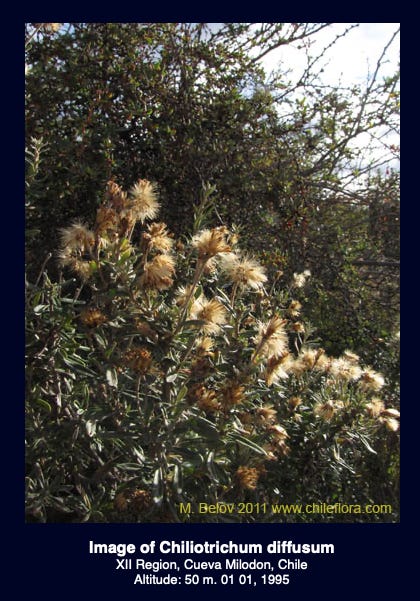
You know an aster after the flower is gone because they fly. Every aster has pappi, the tiny fluff wings of dandelions are also the way the mata verde distributes its seeds. When autumn comes they take flight in the endless breezes.
To Better See
Similar to sage, it provides a medicine in the great steppe. The indigenous Selk’nam people have used it as important medicine for the body and for ritual. Concoctions from mata verde have been used ethnobotanically to bring “clarity of vision.” Because of its polyphenols and coumarins it holds a range of medicinal value including antibacterial, antifungal, and antiinflammatory. It aids in digestion. It is also cytotoxic, killing cancer cells. It has been proven as an antinociceptive meaning it blocks pain.
Traditionally this herb was used to heal cramping, headaches, and memory. It was used to treat ailments of and around the eyes. Likely this is related to the anti-inflammatory way it works with conjunctiva.
This doesn’t mean it tastes good. It’s not food. But it will make a person better.
The Selk’nam people’s is a testament to the land they live on. The Selk’nam people, the few that there are, see the land as the bodies of their ancestors. Language cannot even translate the entirety of the plant, cannot reach around its sides. Medicine would do more than heal the body if one saw their body as directly connected to the land.
A Tangled Home
To get to the islands one must travel over the roughest seas in the world, traversing the Falkland Currents, the two main islands and the 200 surrounding islands that have been freely moving since Gondwana, one of the first land masses split apart.
Mata verde grows in the sun, but sometimes it can fringe the Nothofagus forests - Full of southern beech trees with grey and twisting trunks that are common in the Southern Hemisphere.
Mata verde itself means green forest, because of the role this plant plays on the steppe. It is home, food, medicine, and a keystone to the ecosystem. It provides a home for the small animals of the region and it is pollinated by the pampas white moth and the Patagonia giant bumble bee (sometimes referred to as a giant flying mouse) and other such insects. The flowers call to their pollinators with sweet nectar. Within the tangled branches grass wrens raise young.
It blooms in the southern summer between December and February. It blooms somewhere far away as I write this.
It is freezing nearly all year-round in this part of the world. Patagonia and the Falkland Islands were just as affected by colonialism as the rest of the Americas - and the world. Ships would pass through before the Panama Canal was built, and industry infiltrated the land. Sheep were a major commodity, and remain this way. The sheep are the major browsers of mata verde and the reason for its decline.
This climate is so windy that there can’t be much in terms of temperature extremes. Wind just blows the warm and the cold equalizing the two. This is why we need the wood branches. This is the purpose for the trichomes: to manage the comings and goings of water and wind. Sometimes the plant will grow near places where water that comes and sits in the ground nearly freezing so the dead plants become peat which is ancient, without oxygen, taking a thousand years to decompose. A Falkland fox who died in one of these is remembered, tongue to tail, by the land.
I have never seen mata verde. I don’t know its scent. write this as a translation of a translation. But I piece the story together with the fragments of knowledge I have to understand: The cold, the fox, and the seal. The way wind has no mercy. The woody branches of a xeric tree, the tightly packed leaves of sage, the face of a daisy, all make an approximation to mata verde, which is so far away from where I am right now. I think vision is a conglomeration of understanding. A person could walk by this plant in Patagonia and not see it. A person could walk for a thousand miles looking for a daisy and miss the answer. We must learn to see around that which we interact with, to use our faculties to piece it together in its context. Because to truly see is more than just a function of the eyes.
myth for mata verde
Text for myth, https://macaulaylibrary.org/asset/964, black footed albatross pair
Forager Friendly?
Not really! But, right time, right place, respectful harvest. Maybe.
Sources:
https://en.wikipedia.org/wiki/Chiliotrichum_diffusum
https://www.sciencedirect.com/science/article/pii/S0102695X13700899?ref=cra_js_challenge&fr=RR-1
https://temperate.theferns.info/plant/Chiliotrichum+diffusum
https://gristlyhistory.blog/tag/selknam/
https://www.burncoose.co.uk/site/content.cfm?ref=Chiliotrichum+-+Growing+Guide
https://animalia.bio/patagonian-desert
https://nowvertakking.com/the-patagonia-giant-bumblebee/
https://amrdc.ssec.wisc.edu/about/weather-and-climate
https://www.chileflora.com/Florachilena/FloraEnglish/HighResPages/EH2237.htm
https://www.treesandshrubsonline.org/articles/chiliotrichum/chiliotrichum-diffusum/
https://amrdc.ssec.wisc.edu/about/weather-and-climate
https://pfaf.org/user/Plant.aspx?LatinName=Chiliotrichum+diffusum
https://www.uvu.edu/crfs/native-plants/psilostrophe-sparsiflora.html
https://www.sciencedirect.com/science/article/pii/S2530064424000257
https://www.indefenseofplants.com/blog/2020/10/21/southern-beeches-and-biogeography
https://pmc.ncbi.nlm.nih.gov/articles/PMC12639682/
https://www.nationalgeographic.com/animals/article/falkland-islands-wolf-fox-origin-people
Scrapbook for Mata Verde…
