
That's Kudzu!
A four hundred pound secret

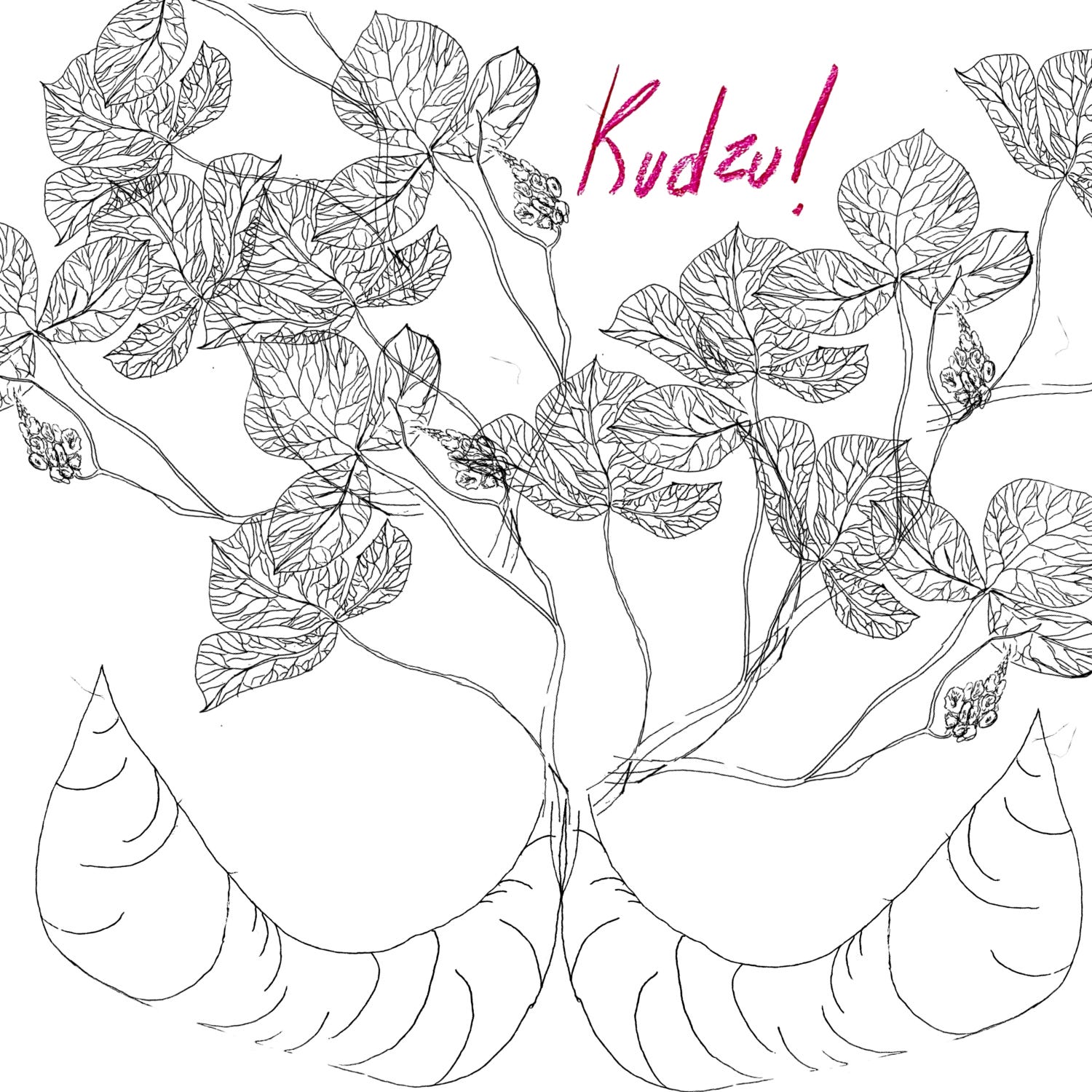
ALSO KNOWN AS: Pueraria montana, Pueraria root, gegen, kudsu, Japanese arrowroot, arrowroot
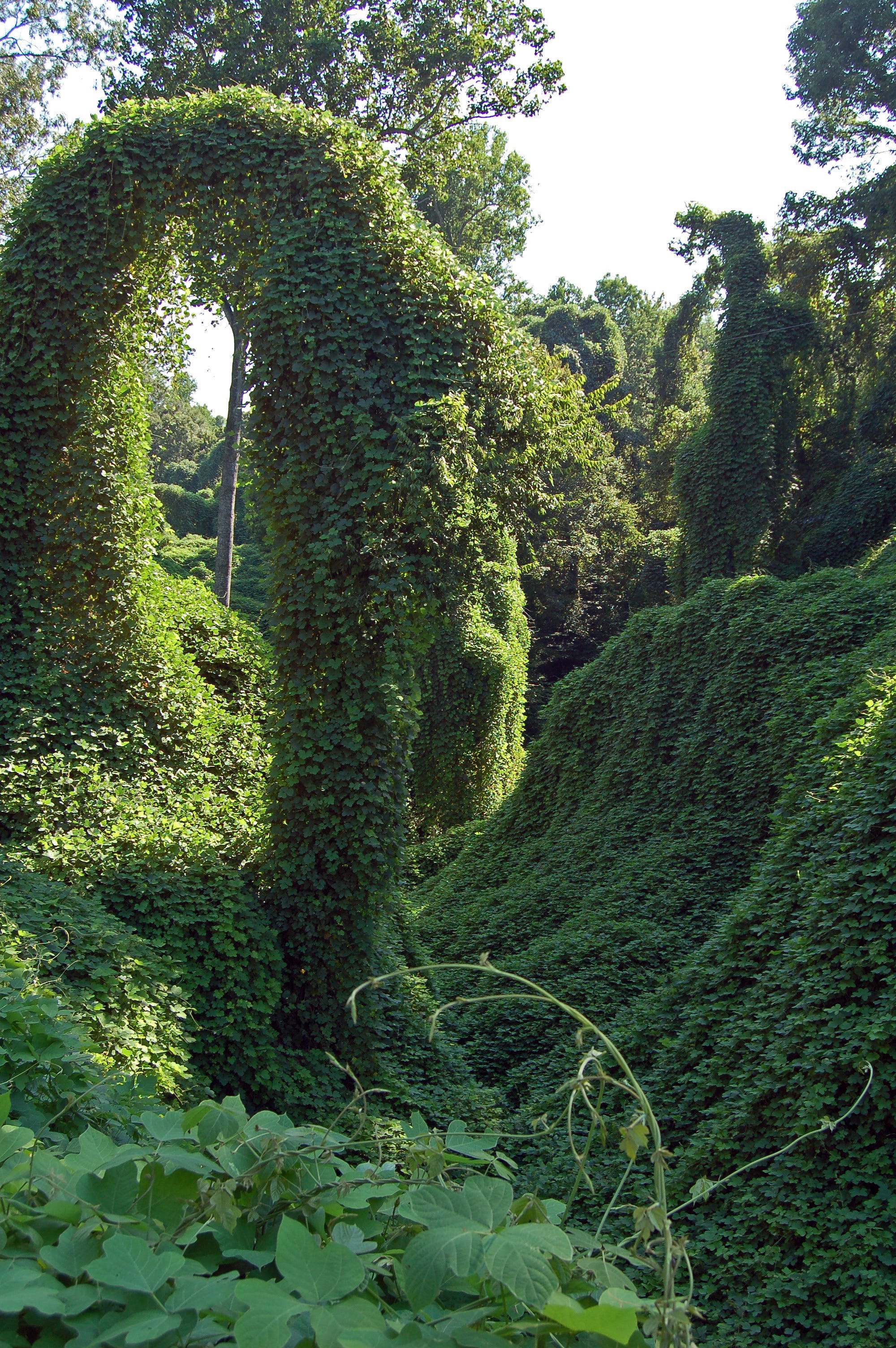
It’s not wrong to be afraid of kudzu. You wouldn’t be wrong to fear it would consume a place. You would be right to fear what’s crawling in the depths below the leaves. Their vines will move much faster and with more resources than we could muster alone. If we were to fight the vine, that is, we would likely be outsmarted. The myth is that kudzu ate the south, but in doing so, kudzu did what no other plant has been able to do. It took on the shape of a giant.
I realized I was scared to write about kudzu. I believed it was not my story to tell. But kudzu is moving north. It’s gobbled up a spot of land in Westchester and it’s going to like New York’s tropicification. It’s going to get warmer here in Brooklyn, regardless of what we do. I’m about to be part of kudzu’s story because it’s on its way to me now. So I open my door, just to peek at what’s to come.
Kudzu has had many lives and every one of them is grand.
A Broken Promise
The first thing to know is kudzu is a vine that will twine around objects no bigger than an antennae when they’re soft and new. Give them a season to rev up, though, and once summer gets going the vines can grow a foot a day. Soon those tender shoots turn woody and become heavy lianas - the muscled woody vines Tarzan might trust with his weight. There is a completeness to the way kudzu will overtake an entire region. Oceanic even, rippling with leaves and alive below the verdant surface.
The noxiousness of kudzu is supreme in the southeastern US north all the way from the great lakes to Florida and from Texas to Long Island with a heavy concentration in Georgia, Louisiana, and Alabama, though it’s native to southern China, southeast Asia, and Japan. Even though it spreads easiest through roots, the spread by seed was the way it got around in the American south. The three years it takes the seeds to germinate require them being tumbled and scratched, until their skin opens a little, and then: crack. So even when people rid them of their land, the seedbank in the soil stays right there and grows back as it pleases. It’s that root that makes it go. The vines will launch roots into the soil on stolons: aboveground roots that make a net over the ground.
Japan felt “new” to the Western World in 1867, a far away place whose society held under the Meiji period might have felt like seeing the soil when one lifts up a rock to see the earth beneath, the exoticism happened then, how world events turned like big winds then. The 1876 World’s Fair Japanese pavilion in Philadelphia showcased porcelain and bonsai and miniature forests. People fell in love with the plants, and kudzu was a pretty cousin to wisteria there. From that point it was occasionally used for verandas because its rare flower smelled like grapes, and its vines gave forgiving shade in the hot summer.
Between 1867 and the concerted growth of kudzu in the south in the 1930’s, the United States attempted once again to become something without destroying itself altogether, but then a scourge blew over the country. My grandmother grew up in a small farming town in Minnesota. She remembered the way the dust settled on everything. A line of dirt outlined a baby in a crib.
The south had similar problems. Cotton had sucked the soil to its last. In the 1930’s kudzu was officially put to work by the New Deal’s Soil Conservation Service (CSC) employing workers to restore the soil that had been destroyed through hundreds of years of planting monocultures in the south. Solutions were necessary and kudzu came back. There were early evangelists, but the most prominent was Channing Cope who believed that kudzu would do the work for you. He called it a “porch plant.” You could sit on your porch and watch it go. It could be woven and made into textiles. Some went ahead and smoked it. It was said to be run by “motor oil.” The trellis vine, the medicine, and the kudzu jelly, were all secondary benefits to the farming work it would do. Advertisements called to use it as forage for cows. Like many bean plants, kudzu has an expansive relationship with microbes in the soil, and as a result nitrogen overflows out of them, leaving the soil rich. And crops love nitrogen, so kudzu would heal an ailing earth, and its lacing roots acted as a soil stabilizer. Kudzu was planted on rocky hills and in gullies. This was a plant that represented financial hope. Abundant to points beyond sanity.
Kudzu would heal it all, make it rich again - make the south rich again.
By 1946, the CSC planted 300,000 acres of kudzu. Farmers were paid to nourish their soil at $8 per acre. Everywhere soil peaked out, wherever plants suffered, there kudzu would go. Desperation was what brought kudzu to where it is today. History shows that solutions that are meant to solve a single problem without taking into consideration the entire picture have disjointed outcomes. Maybe kudzu would have been a plant that could be managed if it wasn’t put on a pedestal, a superhero of the botanical world. It is easily controlled when it’s growing up, but once they touch the ground they start to move. Influence spread just as quickly as kudzu might: a mile a minute, but maybe that’s an exaggeration.
No Southern riot of enslaved people completely overthrew the south. But the paranoia remained and it took the form of kudzu as the plant seemed to rise up against desperation and an empty desire to have massive plantations back in the south. Alice Walker, on the tenth anniversary of the March on Washington, compared kudzu to racism. People said snakes and various biting insects lived in it. Then the plant seemed unstoppable. Left for too long and entire houses, and electrical lines were consumed by the climbing vine. It grew onto bridges and wound around train tracks so that the trains pummeled the roots to a soft mush and crashed. A 2010 study showed that an influx of kudzu actually produces air pollution. Even cows died from eating too much of it. Walker said that racism, if not managed, would take over.
There is a class story here, too, where communities that don’t have the financial resources to eradicate kudzu have a more difficult time with it. It - like all invasive species - thrives on neglect.
A quick fix can feel really good. It can feel like the only kind of fix there is after a certain amount of them, when the boat is going down and you’ll trade anything to turn it all around.
An Anchored Sea
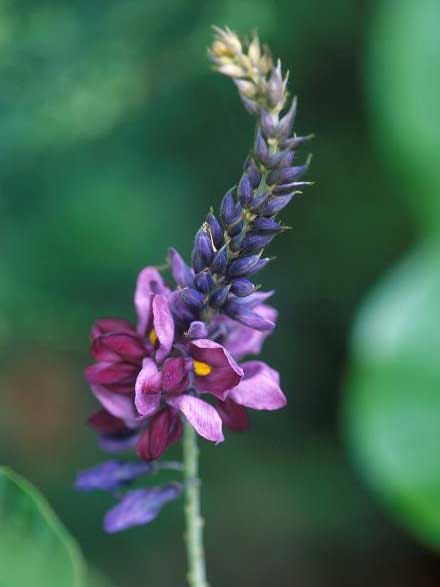
The Pueraria family is a subset of peas. A kudzu flower is rare. The purple flower is layered in rounded petals like all beans, clover, and soy. They are brilliant purple in upright panicles that can be between 2 and 12 inches and open from the bottom all through summer until the early reaches of fall. Upon first glance, one might not see that the grape colored flowers are made up of petals. But there are five of them, covered by a banner with fused petals and wings. In the center are about nine stamens and a pistil. The flowers only bloom when the plant is climbing upward. They want to be closer to the sun. Once pollinated a rusted hair covers the bean pod, just as it did when the plant was young. As they get older they lose these hairs and harden. The vines are tipped with large trifoliate leaves, one central leaf and two going off to the side, soft with undulating lobes. The plant needs a lot of rain, warm summers and mild winters. This is why kudzu has remained where it has for so long.
Jokes and tales and lore grew: don’t leave your tractor alone for 30 minutes. Don’t leave your windows open, they’ll crawl in. Tendrils looking for places to climb. The vines will take hold at a node if they’re cut. The roots survive in drought and feed the plant even in non-nutritious soil because they can get up to 400 pounds. They’re the size of superhero thighs. The root crowns establish and they tangle and the vines that grow from its top can be 80’ in all directions.
Talk to someone who has tried to rip it up and hear the frustration in their voice. Imagine the terror of trying to get rid of an impossibly tangled vine and then realizing that under the soil there is a massive root happy to grow new shoots at the end while you were busting your ass trying to get rid of its next door neighbor’s shoots. The root can die if you keep cutting it off. However, this according to Cornell: “Mechanical harvesting of Kudzu by mowing vines and root crowns every two weeks can take up to 10 years to completely eradicate.” That is only one of a sea of green.
And yet, kudzu is not as invasive as people think. They don’t really grow in forests, so they outline the edges of shaded places. One study showed that they grow in less than one tenth of one percent of the south, far less than other invasive species.
Come winter and kudzu loses its leaves and the sea of green becomes a heavy cover - faded gray and brown that traces the hills and valleys. The illusion of immensity is undeniable.
The Green Ghost
Before the big American kudzu story, there is a deeper millenia of kudzu story. Known as Koshu in Japan or Gengen in China, the plant has been cultivated for generations before it came to the World’s Fair. Now, it’s feral because for many years, varieties of it were cultivated and how it’s grown and changed in the southern atmosphere. In Japan it is one of the seven herbs of autumn or “nanakusa.” There is not one part of kudzu that is poisonous or otherwise inedible.
Kudzu is a valuable herb in Traditional Chinese medicine. The remedy is warm and pungent to the body. In western science it has also been proven to treat alcohol addiction and help the body process alcohol. Kudzu treats heart diseases, menopausal symptoms, diabetes, neck or eye pain, and body sores. Flavonoids mean that it has antioxidants that can be preventative to cancers.
The starch from the root is used in making mochi and noodles. They have been used for healing colds and aiding in digestion. The flowers have traditionally been used to treat dizziness - vague though poetic. Suffice it to say, there are cerebrovascular treatments made from kudzu. Leaves can be tasty, especially at the beginning of the season. Kudzu can be woven. Harvest the vines in the winter when the sap is down and they don’t break as easily. With pounding and soaking, this is how to get the best source for a kudzu textile.
Kudzu is host to the kudzu bug, a small round being that is very much the color of a pebble or a fat tick, and it can kill a stand. The kudzu bug was spotted in the southeastern US in 2009. It needs the kudzu and it eats it up. Theories about how to manage invasive species can be very involved. One of them is that their predators be set upon them. Like the kudzu bug. But the bug is part of the stink bug family. So it smells bad. Which seems like a silly problem. But I’ve never smelled it.
Like most American things, kudzu was far more complex than a good thing. It was no superhero or magician, it was very real and it has a 400 pound heart. The vines covered many places that people called home. Americans are good at tall tales. The crazy stories. Let me say something about the south, though. The southern United States, around Georgia, Alabama, Louisiana, these states are right below where the last glacier stopped. Here animals and plants stayed. The southeastern US is one of the most biodiverse places in the Americas as a result.
This place is special, and worth a great deal of care.
Gothic literature of the south portrays the decay, the overwhelm. The stories of the plants in the United States tell the story of human history with the place, they whisper stories in the background that if people listened there might be an invitation to enter a path beside these plants. This is not a question of control, but one of responsibility. Notice the word “response” in responsibility. It grows in sunny areas so that’s where the myth comes from. It creates landscapes of itself to give the illusion that it is everywhere, but it is everywhere in the sun. When we tell a story we light up that story - that part.
It’s not the end of the kudzu story. In a way, it’s only the beginning. The lighting is changing.
myth for kudzu
Forager Friendly?
Yes! But be careful about the laws wherever you are about how to travel and manage the plant. Harvest responsibly.
Sources
https://extension.msstate.edu/publications/kudzu
Stuff you should know
Rootbound Podcast
https://pubmed.ncbi.nlm.nih.gov/9461670/
https://pmc.ncbi.nlm.nih.gov/articles/PMC4712354/
https://pmc.ncbi.nlm.nih.gov/articles/PMC2890437/
https://ccenassau.org/environment/invasive-plants/kudzu
http://kic-update.com/en/text-en/2927/
https://en.wikipedia.org/wiki/Pueraria
https://babel.hathitrust.org/cgi/pt?id=coo.31924001245848&seq=21
https://pmc.ncbi.nlm.nih.gov/articles/PMC2890437/
https://pmc.ncbi.nlm.nih.gov/articles/PMC4510012/
https://www.smithsonianmag.com/science-nature/true-story-kudzu-vine-ate-south-180956325/
https://www.atlasobscura.com/articles/kudzu-american-history-decoration-fodder-erosion
Kudzu: Maligned Vine - Stuff You Missed in History Class
https://kudzuculture.net/about/
https://babel.hathitrust.org/cgi/pt?id=coo.31924001245848&seq=14
https://www.sciencedirect.com/science/article/abs/pii/S0378874111000729
https://www.nrcs.usda.gov/plantmaterials/flpmcar12920.pdf
The world was my garden: travels of a plant explorer
“Kudzu: A Love Story” Humus and Humans Podcast
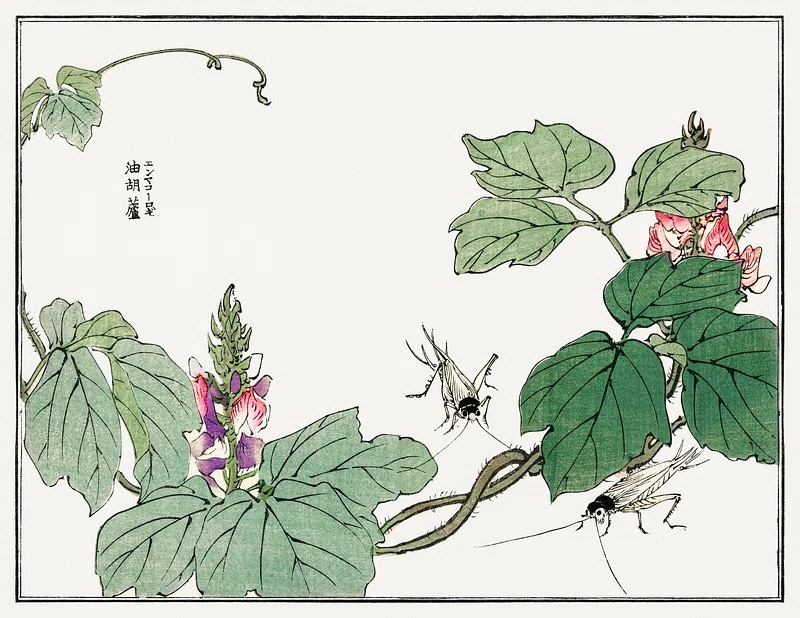
Scrapbook for kudzu…
