That's Iris prismatica!
Speaking in color

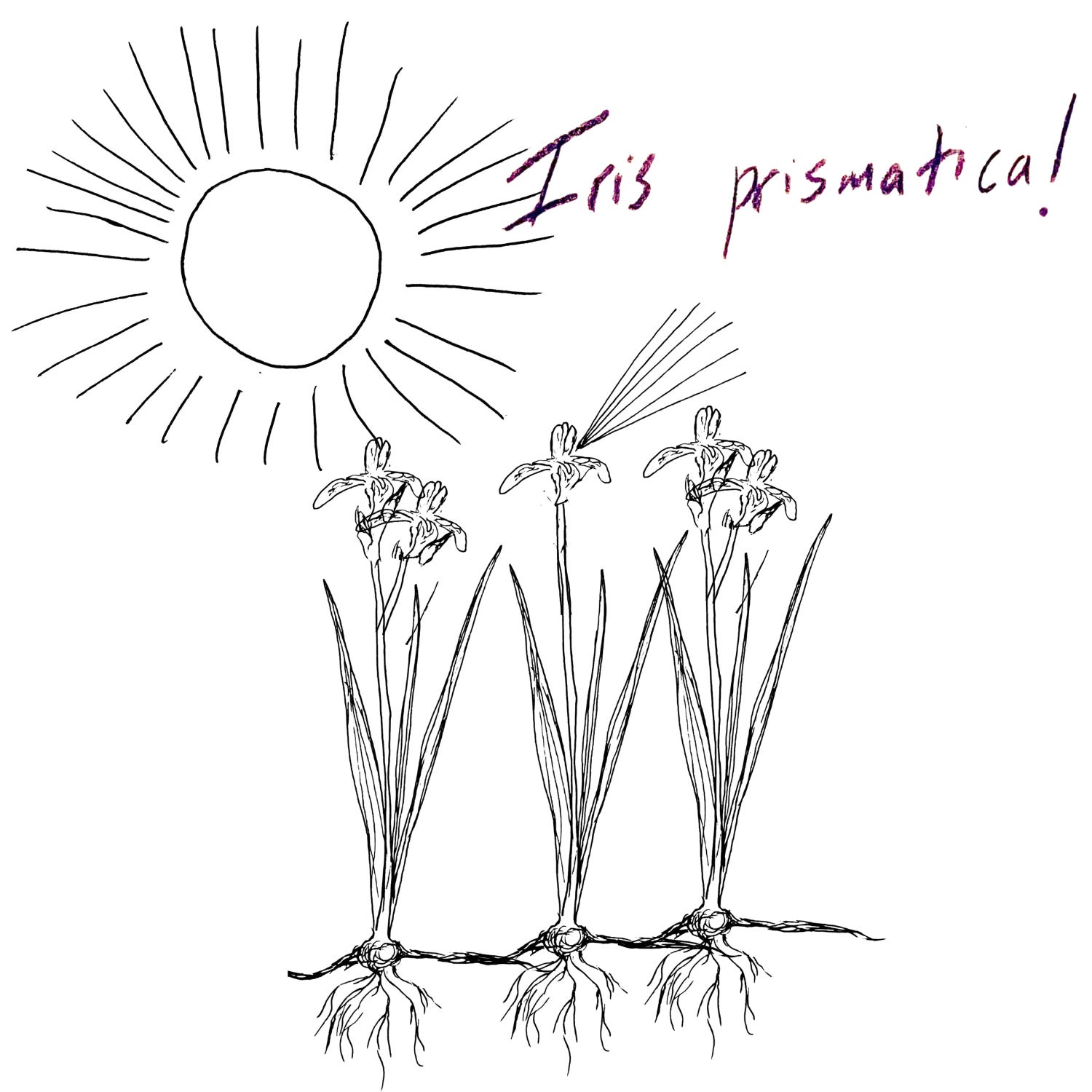
ALSO KNOWN AS: slender blue flag, cubeseed iris, ditch lily, poison flagroot
When the breeze is right, salt fills the air. A quiet reminder that New York is a city by the sea. There are so many answers in the wind. So many signifiers if we pay attention.
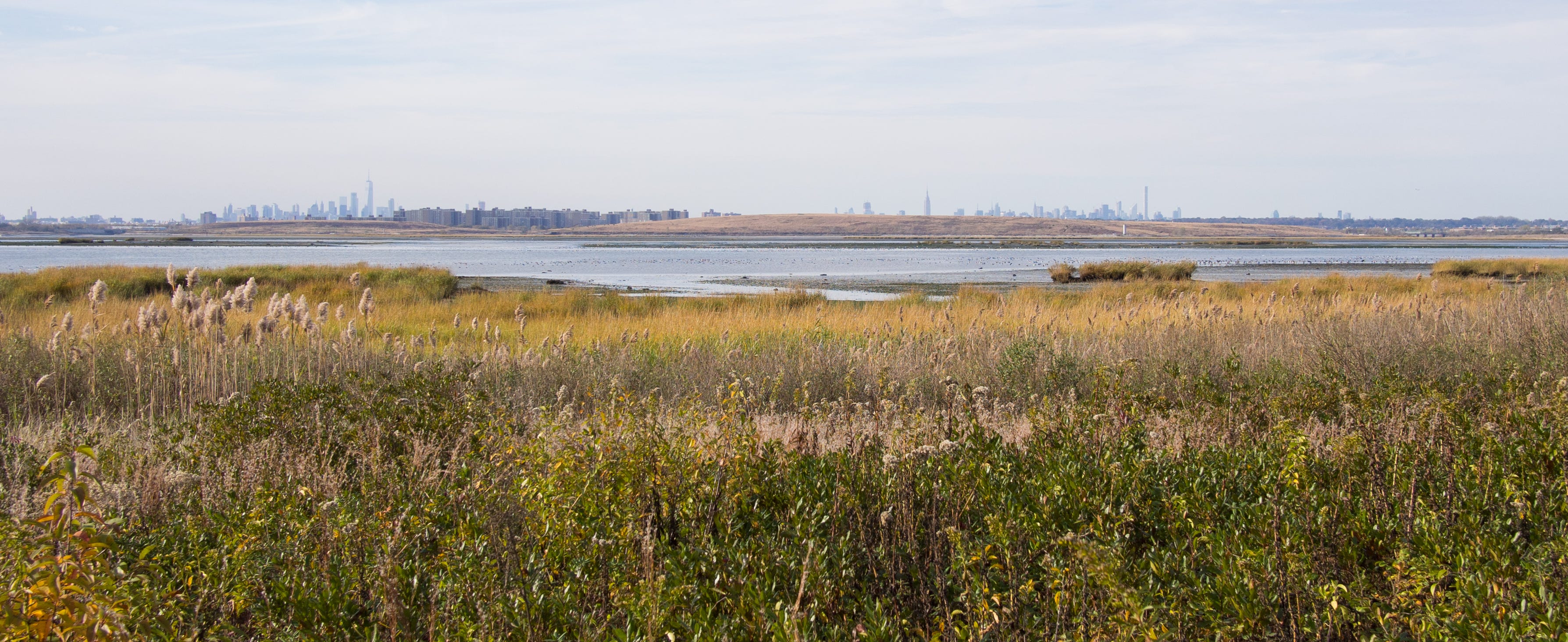
Once, salt marshes made up much of the ecosystem of New York City’s archipelago. Shallow water was home to seagrass and reeds that could survive in salty or brackish conditions. The upland stability of ancient metamorphic bedrock sustained large forests - and now - high-rises. Streams descended to expanses of marsh. The miracle of New York City begins with the land. Worldwide, marshes have historically been some of the most valuable ecosystems with rooted vegetables, medicinal herbs, and plants for textile.
I don’t need to tell you, though, that New York City’s constant construction has made it difficult for native plant species to thrive. But this doesn’t mean some don’t. I also have a hunch, that the dense population doesn’t mean that there can’t be significant ecological restoration here.
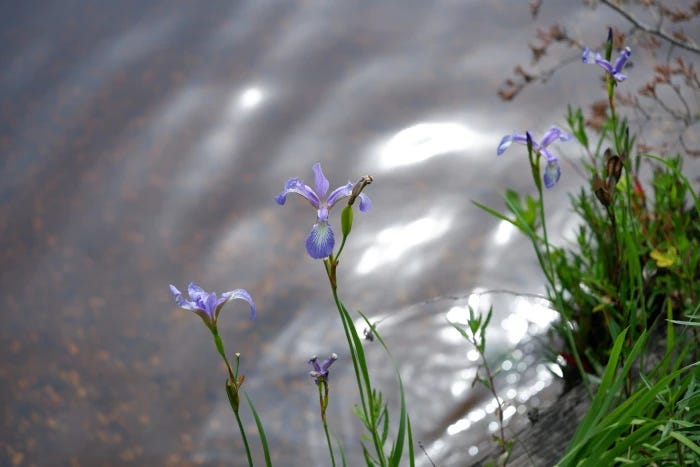
Unlike many of its freshwater kin, Iris prismatica singularly marks the brackish salt marshes with tiny explosions of purple. Glowing magenta in the splayed flower. Plants that survive in salt water have smaller, denser cells with thicker epidermal or outer cells than their freshwater counterparts. And yet Iris prismatica crosses borders. They can grow beside cranberries in freshwater bogs. There are about 260 species of iris and all of them require some form of wetland. Irises are native to the entire northern hemisphere, but Iris prismatica lines the Atlantic, from North Carolina’s coastal marshes to Portland, Maine, with a high concentration in New York, New Jersey, and Pennsylvania. This three-state land is Lenapehoking, the land of the Lenape people.
Of the Wind and Water
Monocots are newborns in the scheme of floral evolution. They’re all straight lines, bold, geometric shapes, bulbs, and they count in threes. Lily, daffodil, tulip, onion. They appear to have nine petals in all, but it’s three sets of three.
Of all of the monocots, iris’s flower sets it apart. Three outer sepals - thick - called the falls. Compared to the Eurasian beared iris, these sepals are narrow. The three inner upright ones called standard. They’re true petals, and three illustrious thighs of the pistil lying atop the curved falls.
No wonder they’re compared to peacocks. The pistils are wide as tail feathers. The way the sepals open they look like bridges. The flowers themselves stand on the ends of forking stalks. Iris prismatica is no more than three feet tall and three inches wide, populated by roving carpenter bees and hummingbirds. The stems are fibrous, thin and reddening at the base. In late summer the seed pods will be ovular and green, outlining between two and three chambers of seeds. They split along a thin dark seam once autumn clutches the plant. Food for birds.
The rhizomes are narrow bootlaces that wind in the mud and shoot up at the thaw. Flag is a common term for all iris species. It likely comes from the Danish flæg which means “fluttering in the wind.” Old English adopted the terms using it to describe reeds, and so iris embodies a plant that stands in the shallows where the wind fringes the shore. A sign.
The Prism
Iris is the first plant of all the western plants in the ancient botanical compendium, De Materia Medica by Dioscordes. In ancient Egypt it was listed among the medicinal plants on a 3,500 year old slab. Its deep purple was used to illuminate manuscripts, tucked in the gardens of monks, to communicate the glory of divine words. The robust, masculine, Fleur-de-lis is based on the iris.
And still, the name, Iris, continues.
Maybe you’ve chatted for hours with an Iris.
“Iris--
quick as the wind and speed this word…”
-The Iliad
To the Greeks, the goddess, Iris, was described as quick. A sentence with her would not end without there being some mention of the wind. Her voice spread far and connected with others immediately, like a furious breeze, or the internet. Iris holds the actions of the Iliad up with her quickness. Though in Greek tradition she is connected to the words of Zeus, the association with the thunder god continues in Slavic tradition where the word for iris weaves into the name for the thunder deity himself, Perun. An entire genus is named Perunika.
Irises are, in very real ways, communicators. Japanese tradition has cultivated a deep respect for iris, using it not only as a marker for the change in seasons. In Japan the bloom of the iris in late May and early June signified the time to plant rice. For this bloom there is the Iris Festival where iris tea is prepared and young men bathe in pools with iris blossoms. In the northern hemisphere it blooms two or three times, marking the very beginning of summer, far now from the ephemeral early buds and touches of frost that scatter through April. Iris blooms and blooms, and stays.
Touch its roots and get rashes, Iris prismatica might be poisonous but it has been prepared as an antioxidant, protecting from cancers and contributing to heart and blood health. It is also used to treat skin conditions. And here is where iris finds its way to our bodies. Through perfume. Countless perfumes feature iris, the fragrance is the meeting of soil and nectar. There is also a fragrance that’s also used as a spice in Morocco called Orris. It is the dried rhizomes. Some even call it “powdery,” a vague smell that feels stuffy and vintage, but comes from the volatile compound irone featured in the pallida. There is likely some irone in the Iris prismatica, though studies are sparse.
At a traditional eight plank bridge often zigzagged across wetlands, a traveler improvises a poem in The Tales of Ise written during Japan’s Heian period. The poem itself is an acrostic with the word “iris” within it and the traveler mourns the his distant love. To love is a way of understanding the dual meanings of our familiar people. An inside joke. Irises stand by many boardwalks, like the ones in Louisiana where Gary Salathe is restoring the native species there, planting hundreds of seeds each season in backyard swamps with a giant roster of volunteers.
In Japanese tradition there is a turn of phrase comparing Iris sanguinea to Iris laevigata, meaning one is choosing between two elements of equal value. The tension might be paralyzing, though I like to think it is not about the choice itself but the beauty within choosing. In the way light hits a crystal and breaks it apart. To truly see something is to acknowledge the multifaceted nature of it.
So we arrive at the eye. Iris, of course, is the name of the flower in our eyes. The goddess herself represents rainbows. And too, the iris flowers have been bred into nearly every color, which says something about its genes. Iris prismatica’s falls have the distinctive veins that match the collagen lines cracked through our own irises. The alchemists saw iris as the “peacock’s tail,” the integration of color representing the unity of all the selves we contain. Iris shares the same root in iridescent, meaning multicolored. Multicolored: our eyes’ namesake.
Flying through the air on the wings of the sun, eyes define the value of color which in turn provides understanding, delineation.
The global preoccupation with the iris plant does not take away from the fact that many North American species are threatened. Not because they are not fast growers -they are. Or adaptive, but Iris prismatica is going extinct because salt marshes are dredged, construction flattens, and pollutants weaken wetlands.
On those evenings when Brooklyn rolls itself out to the storied Atlantic, that bit of salt water feels like a warning. Even though we can’t directly see the ocean, we feel the movement of it. We always do in New York. It’s rising, lapping at our feet. Iris prismatica might have grown where I stand on this concrete block beside clinging street trees, earnest grass like leaves.
Over the rolls of the ocean, is it those same storms clouds where the Lenape girl walks? Her myth tells about the time she followed a man into the lake of snakes and became full of them. Rescued by a rain cloud, now every time she walks through the world with her companions of thunder, her garments crash. There must be someone who translates the water whether that be the thundercloud or the deep ocean.
Quick, pay attention to this place that echoes the messages of iris, before the ocean’s hands reach out and take it. There is still time to plant irises and eelgrass and the powerful white spruce.
myth for Iris prismatica
Text for myth, music: Maarten Schellekens, “Into the Unknown” CC BY-NC 4.0
Forager Friendly?
No! But plant them if you can.
Sources
https://en.wikipedia.org/wiki/The_Tales_of_Ise
https://www.etymonline.com/search?q=iris
https://guides.nynhp.org/slender-blue-flag/
https://www.cell.com/current-biology/abstract/S0960-9822(25)01543-X
https://heartoflouisiana.com/red-iris/
https://www.oocities.org/shabak_waxtju/thndrgrl.html
https://www.seattlejapanesegarden.org/blog/2022/6/01/japanese-irises
https://gobotany.nativeplanttrust.org/species/iris/prismatica/
https://www.mass.gov/info-details/slender-blue-flag
https://www.fs.usda.gov/wildflowers/beauty/iris/Blue_Flag/index.shtml