
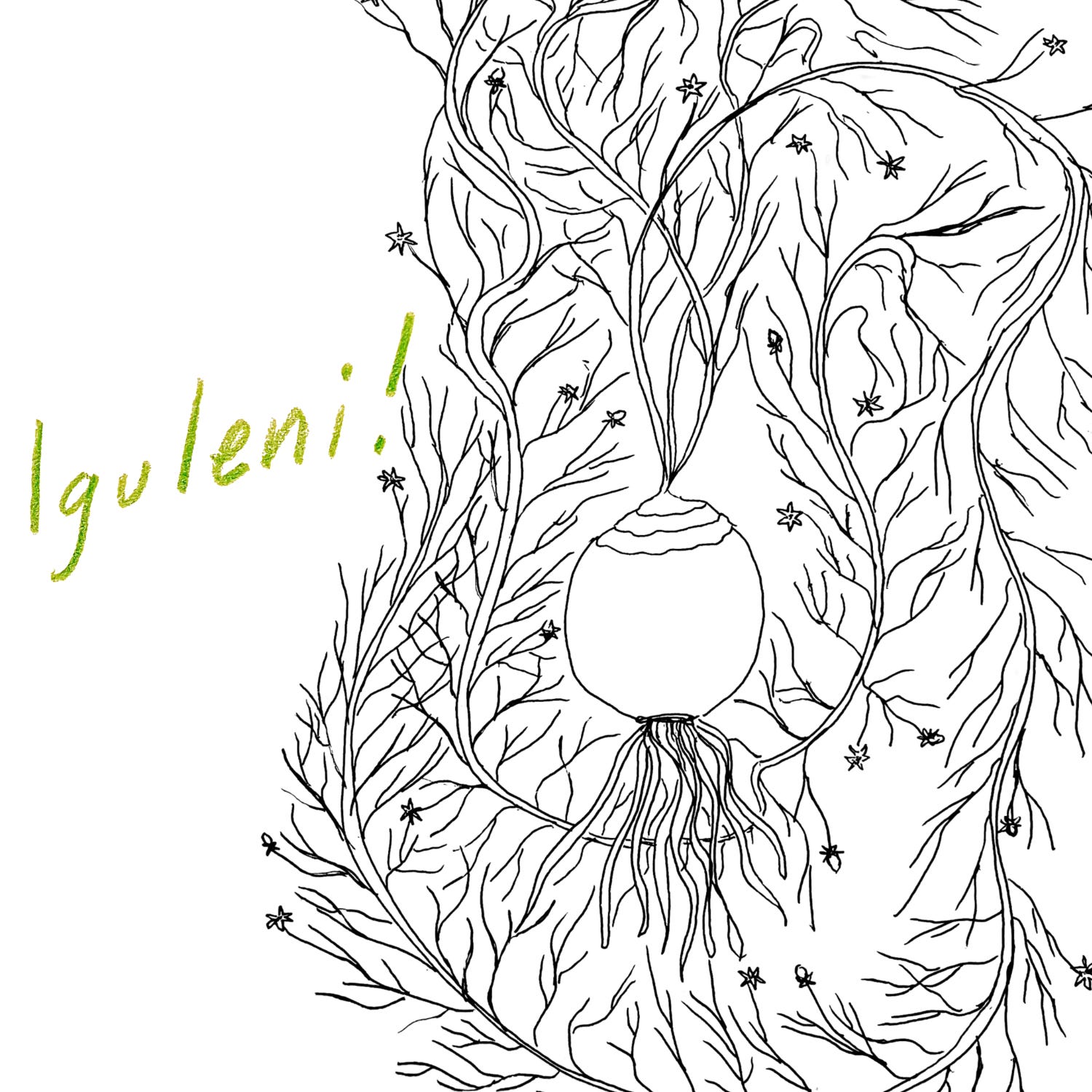
That's Iguleni!
Softer than diamonds

ALSO KNOWN AS: climbing onion, climbing green lily, bowiea (Eng.); knolklimop (Af.); ugibisisila; iguleni (isiZulu); umgaqana (isiXhosa); gibizisila (siSwati)
The Speed of Earth
Not many conditions create diamonds. Immense pressure, rocks, magma, and an initial speed with which the carbon substance rises up from the earth in an underground explosion. Think: carbon, the stuff of the sun, sometimes six hundred miles below the earth’s surface. The shrub land between Namibia and South Africa is one of the sites where diamonds are extracted. There are few places in the world that house diamonds so deeply in the soil.
Cut that old crystal and see the way the layers catch the day as if a diamond could open out and be light, becoming the stuff of its maker. Most diamonds are billions of years old. Resistant to wear, not unbreakable, but almost. Diamonds, they say, will last while all others melt away. Small infinity.
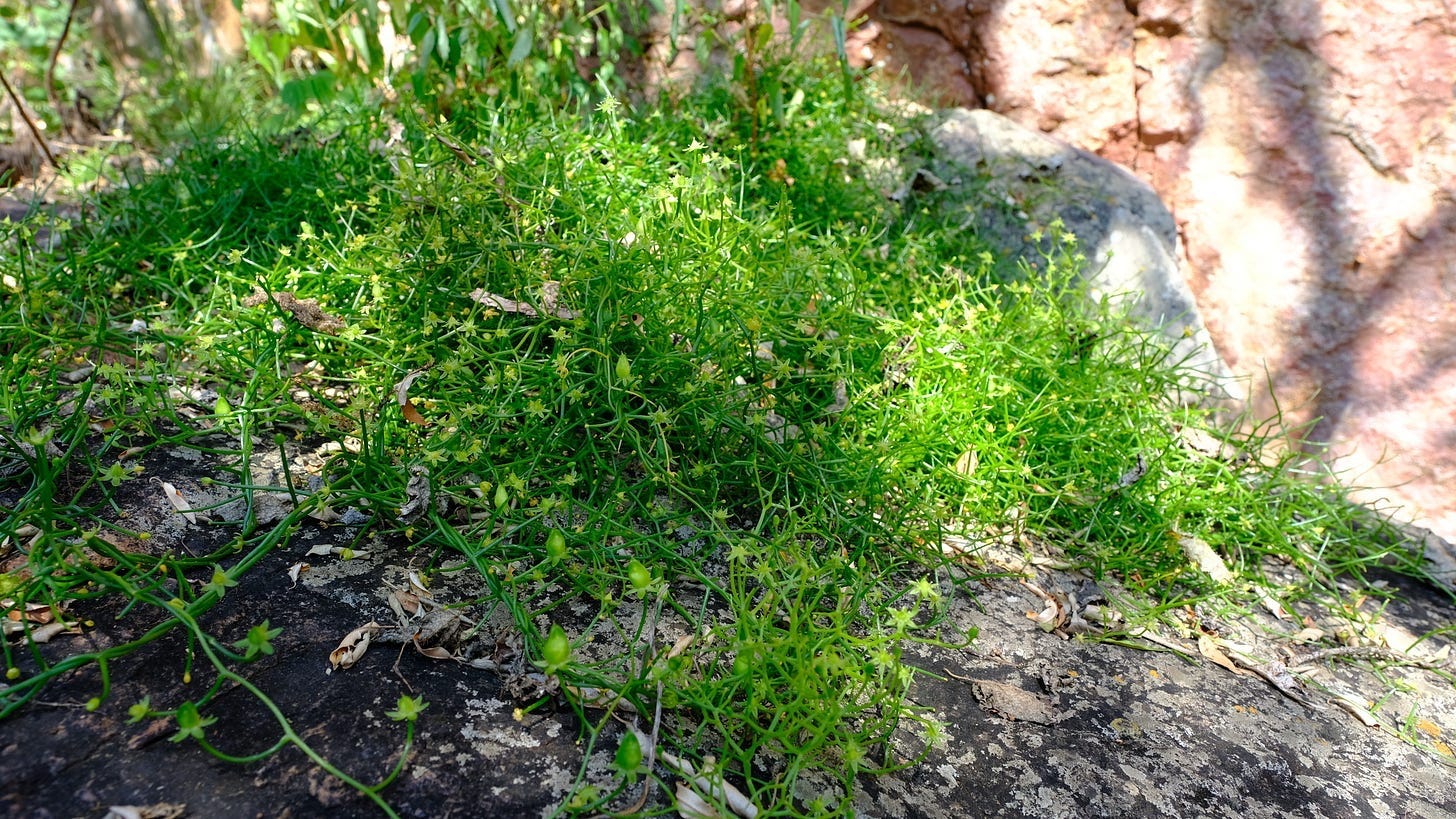
Meanwhile, on the surface of the earth, a thin layer of lichen and moss covers the soil and shrubbery makes up much of the land. Namaqualand is about the size of Cuba. On the granite cliffs, or wending around rivers, or even on long open grassland, are the sea onions, a name that proliferates the internet, not because it has anything to do with the sea. They grow in Nammaqualand, Nama Khoi people’s land and around Upper Southern Africa in a band from around where Namibia, Botswana, and Mozambique border South Africa. Here the xeric, or dry shrubland, blooms are ecstatic carpets of flowers at the tipping into hot weather after the rainy season. Here is where once steenbok and other corvids migrated freely. There are several national parks here now. Which is fine, except over time the land is all tread down, and that thin layer of lichen and bryophyte protecting the soil has worn away, leading to a terrible slip: erosion, the loss of habitat.
In Braiding Sweetgrass, Robin Wall Kimmerer describes soil as being a complete world on its own. The soil we buy at stores is that alive ecosystem made into a smoothie. Good soil is good soil, but these are ecosystems below our feet. I recently found a tiny mushroom in a compost pile I was turning. The earth is constantly churning and creating new life as it goes. Migration is a right.
Cascading Locks
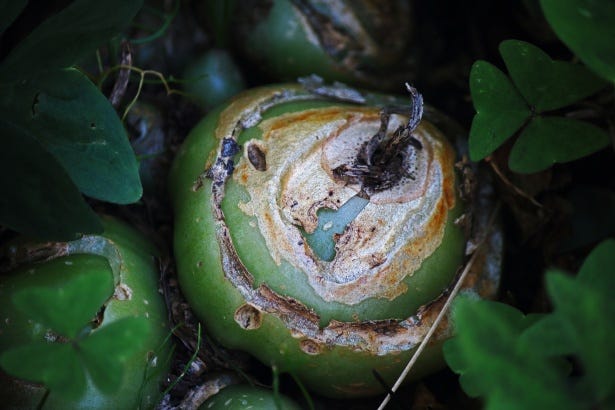
The name “sea onion” paints a picture of its gesture. Sea onion has many names because of all the places it grows. At the moment it is considered a house plant, so all of the names evoke the way it looks and connects it to references far away from its home soil, the Zulu name is iguleni. Like many plants through the semi arid lands of Africa, it is considered a succulent, though it doesn’t shape itself like the American cactus or the aloe. It has one large round container of water, a pale green stem full of a saliva textured mucilage. In any other setting it might look like an onion. Out from the top of this root like a top ponytail come endless stems which rise up out of it and crash, yes, like a wave, in a sublime explosion in the form of vines that dance quite quickly for an herb. While it’s more closely related to hyacinth, this plant is distantly related to asparagus, so its narrow stems are reminiscent of tiny water particles, a mist of a plant. To the untrained eye the leaves are missing. But there are leaves. They’re called cladophyllis and take the shape of flat stems full of stomata that so covertly photosynthesize. Wiry, they hold onto alert flowers at their ends. Everything about the iguleni is built to conserve water: these tight leaves are one, the engorged root the other.
This root is layered with scales that remember how to grow themselves. Crack a single chunk from the stem and plants will emerge from it in three weeks.
Similar to an onion itself, iguleni’s modified root stores water and nutrients for maybe seventy years, or at least as long as any of us will live. Every year during the rainy winter season it grows lush, and in the summer it goes dormant, all of the green ocean it has made falls off and ebbs away as the plant moves its energy back into the fattened stem. Below ground blunt roots reach into the soil and above peaks a rounded old eye jutting out of the soil, peering.
Iguleni’s natural land holds a host of varying traditional cultures and practices. Diamonds are also here, succulents, and long tongued flies. This land is unique and pocked with a tremendous amount of biospheres that iguleni is comfortable moving in and out of.
The flowers are ghostly, with six petals that open in star shapes and, equally, six stamens with pollinated edges. The center is a glossy pistil. When they are pollinated the seed pods grow like tiny green peppers with three chambers. The flat, dark seeds have a low rate of germination because of their vegetal eruptions. While the rounded stem looks like onion, there are profound differences between the plants. One is the way the modified stem can rise above the soil, as if it wants to see where it is, overflowing as it does every way, in form. Even then it gives off daughters, buds that grow up underneath it in thick undulating shapes. During the dormant summer, a crinkly sheath, glittering as shale, covers it. So the bulb can grow to be almost a foot wide as the buds grow up around it, each with their own stems expelling yards and yards of green.
Little is known about their pollination from the standpoint of western research. Someone probably knows. James Bowie probably didn’t though. He was a botanist with Kew Gardens in the 1800’s and his name is still stamped on the taxonomical indexes. After collecting specimens from aloe and the iguleni he wandered around South Africa as a failed businessman and died penniless in South Africa. How is it that these men who traveled to countries far from their home seemed to waste their lives looking and looking, sending seeds and specimens to be flattened at Kew, as if to prove themselves, and then the plants gave them nothing in return.
Maybe they forgot about the soil, so out of context they were flying high above like the iglueni’s leaves, forgetting that the leaves must be caretakers for the soil, and the root below.
Malady and Medicine for the Heart
Depending on the situation, decoctions from iguleni have been used medicinally to treat upper respiratory infections, skin conditions, issues with the liver and issues relating to menstruation and birth. Studies have shown that it does have anticancer properties.
And yet iguleni is poison. A person can’t even touch it without getting a rash. With cardiac glycosides which are also present in foxglove, it can stop the heart of a human or an animal. So for any medicinal applications it has will require extensive research in order to use it. The plant contains anti fungal, antibacterial, and cytotoxic properties. And a heft of alkaloids. The uses are wide ranging and also incredibly specific to the peoples who use them. The list and associative practices would not do justice to the protocols and complexity for the people who use it. This is muthi, a name for potent medicines. It is one of the most medicinal plants in all of South Africa. But because of the massive extraction practices, from farming to mining, or even medicinal harvesting, it’s likely that the iguleni has declined 30% in the last thirty years.
Its magical uses are specific to the peoples where the iguleni grows. As it is with powerful plants, they bleed from strictly physiological to spiritual. Prepared correctly and iguleni will summon bravery, tenacity for travelers, and love for those who are longing.
For something to be precious it must be dangerous. However tender, rounded, and soft. It must be able to break our hearts open. Namaqualand is as old as the diamonds are. The thin layer holding the surface of the soil is just as tenacious as the precious gem.
The secret is that all things break. When we allow our hearts to be broken with them, I think we’ll find daughters grow up around them. I imagine someone walking. Iguleni, who travels over many different places. Their body is an insect with countless legs, and their belly a lake, they can sit on the ground for a long time. Their bag, that’s the thing that holds the world in it. It all rolls around inside the vessel while the figure walks along.
myth for iguleni
Text for myth, music: Johannes Brahms, Waltz No. 16 D minor
Sources:
https://plants.ces.ncsu.edu/plants/bowiea-volubilis/
https://www.sciencedirect.com/science/article/abs/pii/S0140196306004125
https://www.discoverwildlife.com/plant-facts/flowers/namaqualand-flowers
https://pza.sanbi.org/bowiea-volubilis
https://astrobiology.nasa.gov/news/diamonds-and-science/
https://www.llifle.net/Encyclopedia/BULBS/Family/Hyacinthaceae/11066/Bowiea_volubilis
https://pmc.ncbi.nlm.nih.gov/articles/PMC10608581/
In Defense of Plants podcast: Namaqualand Succulents and their Pollinators
https://en.wikipedia.org/wiki/Scilloideae
Braiding Sweetgrass, Robin Wall Kimmerer
https://www.jstor.org/stable/1222630?seq=7
Scrapbook for Iguleni…
