
That's Fireweed!
Who rises from the flame

ALSO KNOWN AS: Chamaenerion angustifolium, Epilobium angustifolium, rosebay willowherb, spukWu’say (Twana), Almaruat, St. Anthony’s Laurel, Ivan Chai (Russian fireweed tea), Lus na Tine (Celtic)
What is more transformative than fire? A chemical reaction that alters nearly every structure and disperses it - completely separating it from what it used to be. The very molecules have shifted, ashes will not be reconstituted. Fire is so powerful it makes that which survives the flame all the more mystifying.
Who Counts the Days of Summer
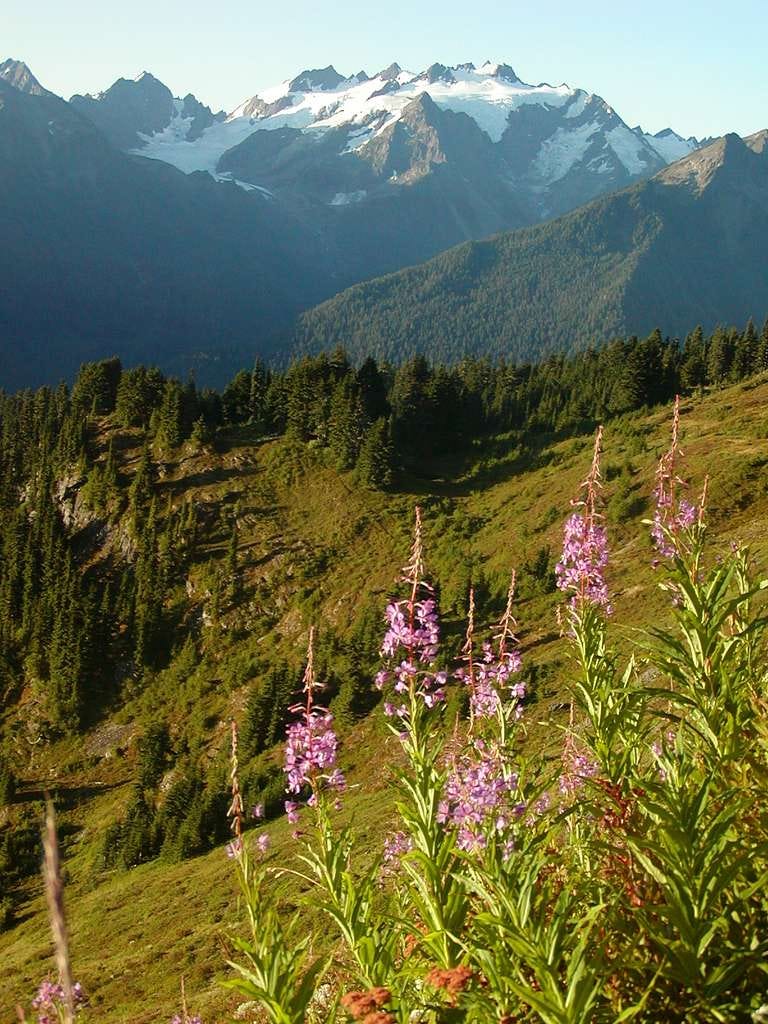
Often known as the trailing veil of glaciers, fireweed blushes in North America. It is a hearty shrub that requires winters, so it has easily found home all over the circumboreal world from Canada to Ireland. They grow in stalks as tall as you are. Their flowers magenta, against the deep evergreen of the surrounding leaves. Fireweed may start blooming in summer’s prime but to many who live beside it, the blooms are a slow clock to winter.
From a distance the flowers could be confused with Brassica — nestled as they are at the top, each with four petals - but they’re different. For one thing, they’re not white or yellow, which nearly all Brassica are. While they have four magenta petals, they also have lanced sepals rayed from their styles - like they’re shining. The pistil comes out fancy, with dramatic swirls at the tip. Below it are little feetlike anthers with pollen. They can be self pollinated. They grow in rooted stems called rhizomes. The leaves are thin as fingers, not like Brassica’s rounded oven mitt leaves.
On the British Isles this plant is called rosebay willowherb because its leaves look like willow. It is related to the evening primrose and fuschia in the Onagraceae family, and all of its names seem to have some sort of relation to other plants. The latin form, Chamaenerion breaks down to, Chamai meaning dwarf and nerion, meaning oleander, referring to the shape of oleander leaves, a plant more closely related to milkweed.
Appropriate to an herb so associated with fire, fireweed has a reddish stem, with no trichomes at all - no little hairs that sense the world. There are no branches - for the most part - along the entire plant, it just wavers as a singular snaking body.
The plethora of lanced leaves whorl around the stem, a leaf would not be much longer than my own hand. There are so many leaves on other plants that look like these ones, but there is something that stands out about their form in fireweed. Look closely to see the way the veins never reach the end of the leaf, they loop back like yarn on a scarf.
Once the inflorescence emerges, it blooms from the bottom up, so the top remains for most of the season like a small cloud of nearly transparent buds crowning it from June through summer’s last moments in September. It’s well known in Alaska, once the final flowers bloom at the tip of the plant, winter has come.
Who Leads the Way After the Fire
It grows in places that have seen destruction, or know it well in the form of burning. They are even known to grow in oil spills. Avalanche tracks. They grow between the boulders, in slightly calcerious, rocky, or sandy soils.
It grew in London after the bombs destroyed the city in World War II. That one war that has continued. Everything is related. We carry history. We become flowers of what has come before. We leave as seeds for the flowers to come. Destruction is a part of life, but the fireweed knows something about the time after. It’s a plant that grows quickly after fires. It was one of the very first to grow on Mt. St. Helen’s after the eruption in 1980. They don’t actually grow back, though, after a fire, rather they live through it. Like phoenix eggs, the roots heat up, but do not burn or broil in the ground. After the fire they shoot back up with all the rejuvenation of earth’s crust behind them and an ashen field will become pink.
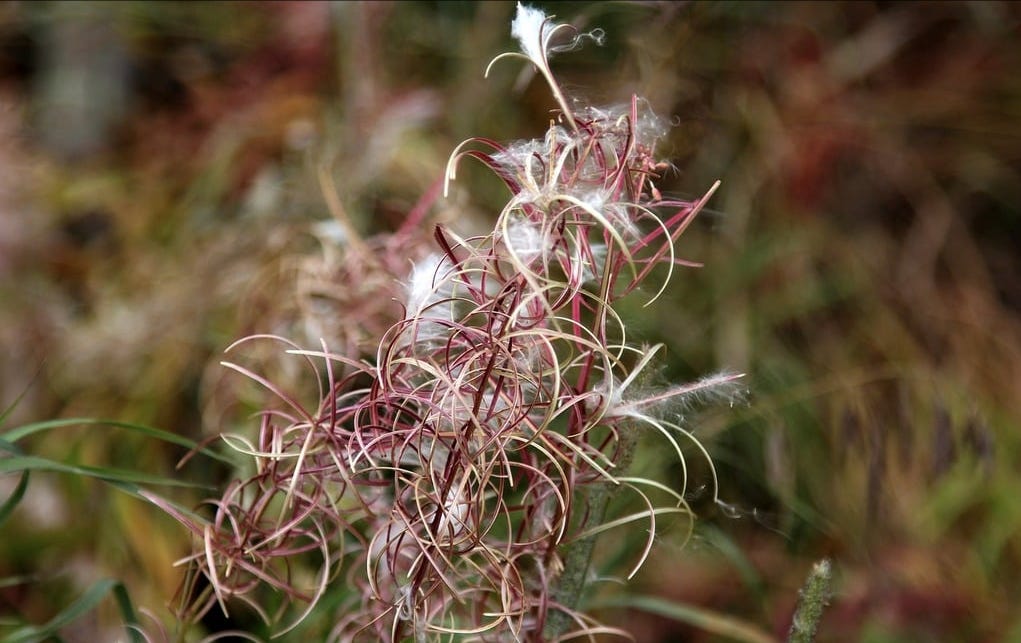
There are up to twenty species of fireweed in Alaska alone. Their long necklike inflorescences make long, almost beanlike pods, but once the fruit breaks open - they peel back like a banana. In all, the plant produces about 80,000 seeds that are fixed with fluff - built to fly. These have been used by indigenous communities for millennia as a textile and as padding. The Salish traditionally have mixed the feathered seeds with mountain goat wool to make blankets. This fine down can also be used as tinder to start fire. The seeds are too small for foraging birds, no bigger than sand they lift off like autumn swarms.
The stem and leaves are edible and have vitamins A and C. They should be harvested when they are still young shoots - which, along with their roots, have beta-carotene, the same red that’s in beets, and flavonoids. These young shoots look like feathers, frilled and cast in soft purplish red, as if colored by the fire itself. They have something called polyphenols, which are used in a range of therapeutic settings. Their roots can be ground into a soothing poultice - it has a smooth mucilage, like aloe. The medicinal qualities of this plant range from digestive aid, to healing sore throats, as an anti-inflammatory, and antioxidant. Their tannins make them a good skincare product as well. After they bloom they become bitter, but this is a good time to harvest the leaves for tea.
Herbaceous plants can have a different kind of structure than trees. Their stems may be hollow on the inside. But more likely their stems look a lot like our bones. In the center of the stalk is sometimes a soft, porous substance called pith. Break a stem and see the three major elements: the fiber, which is the very outside of the stalk. This comes off like little strings, and on many plants, including fireweed, it can be used as jute or rope.
Inside that there is the hard - almost woody part. The bone of our bones - that which allows the plant to stand up. Within that is the soft pith, and in fireweed, the pith is edible. In Kainai tradition it can also be dried and placed on the skin to protect from cold.
In addition to being an important food in their ecosystem, their nectar is delectable. The stems are grazed by deer, muskrat, moose, and hare. The flowers are valuable for bees, moths and hummingbirds. It is the larval host to the dramatic white lined sphinx moth. Their honey is known to be slightly spicy. They are the emblem of the Yukon territory where the nectar of fireweed is made into sweet jelly.
Fires don’t give way to meek plants. The transformative nature of a fire makes nutrients in the soil that plants ravenously take in and shoot up in absolutely stunning performances, little shade to stop them and much in nutrients below them, the fireweed drinks in the sun with a thirst. You’ll see them in meadows. You’ll see them dancing on stems so narrow they look like they’ll fall into a coil. Below ground they grow in persistent, tangled webs made of rhizomes - underground stalks that produce the entire mass of shoots that make up their temporary community. That’s why you’ll see them spread over an entire field. I think about how difficult it is to move through pain, the pain of destruction or the pain of loss. A compatriot reminded me in their essay, recently how when trauma is held - listened to - it is able to be regulated more easily. I am not an expert on trauma, but I sense that when we go through difficulty, it is not the difficulty itself that will cause lasting harm, but the absence of those who are there to hold it, the way it lingers, wound open. That’s why we scab, our emotions need that kind of padding too. I think about the way fireweed takes over like a story told so many times, just to remember every bit of what was lost in the fire, in the spill, in the avalanche, in the storm. Desperately we try to bring it back, like so many fireweed plants.
Once larger trees and shrubs begin to grow back the fireweed will die away. A memory of a burn, an echo of flames fading. There comes a point when healing happens. It just does. Time of pain looks as endless as fields of fireweed. It will never end - the herbs are so high and so close to one another. You can’t reach your arm without touching a dozen of them at once. But they will give way. One the soil is ready, the seed bank renewing, in a soft power, they make way, they give space. They make time.
myth for fireweed
Text for myth, Music: Debussy, reflets dans l’eau
Forager Friendly?
Yes, harvest responsibly
Sources
https://www.wildflower.org/plants/result.php?id_plant=chan9
https://en.wikipedia.org/wiki/Chamaenerion_angustifolium
https://extension.oregonstate.edu/catalog/em-9488-chamaenerion-angustifolium-fireweed
https://calscape.org/Chamerion-angustifolium-(Fireweed)
https://www.alaska.org/advice/fireweed
https://galileo.org/kainai/fireweed/
https://www.minnesotawildflowers.info/flower/fireweed
https://wildfoodsandmedicines.com/fireweed/
https://www.wnps.org/native-plant-directory/86:chamaenerion-angustifolium
https://www.fws.gov/story/fireweed
https://pmc.ncbi.nlm.nih.gov/articles/PMC5045895/
https://plants.ces.ncsu.edu/plants/epilobium-angustifolium/common-name/fireweed/
https://www.illinoiswildflowers.info/prairie/plantx/fireweedx.htm
https://ohiodnr.gov/discover-and-learn/plants-trees/flowering-plants/fireweed
https://www.missouribotanicalgarden.org/PlantFinder/PlantFinderDetails.aspx?taxonid=297622
https://www.fs.usda.gov/database/feis/plants/forb/chaang/all.html
https://ediblealaska.ediblecommunities.com/things-do/things-do-finding-fireweed-phoenix-foraging/
https://www.montananaturalist.org/blog-post/fireweed-a-colorful-reminder-of-change/
https://nativememoryproject.org/plant/fireweed/
https://www.reddit.com/r/askscience/comments/1ifdnl/how_does_fire_function_on_the_molecular_and/

Scrapbook for fireweed…
