
That's Delicate Peatmoss!
An ancestral architect

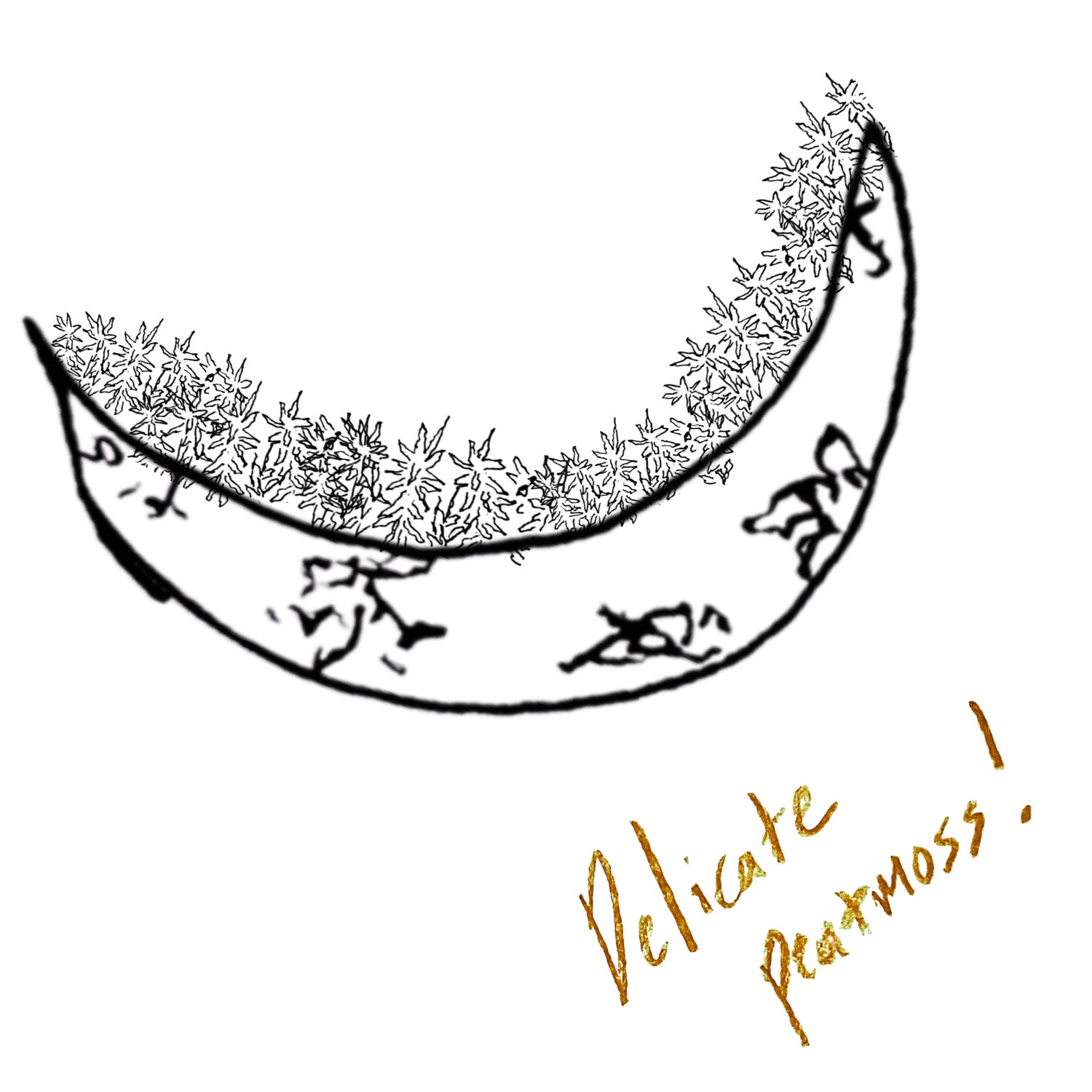
ALSO KNOW AS: Sphagnum Tenellum, soft bog moss
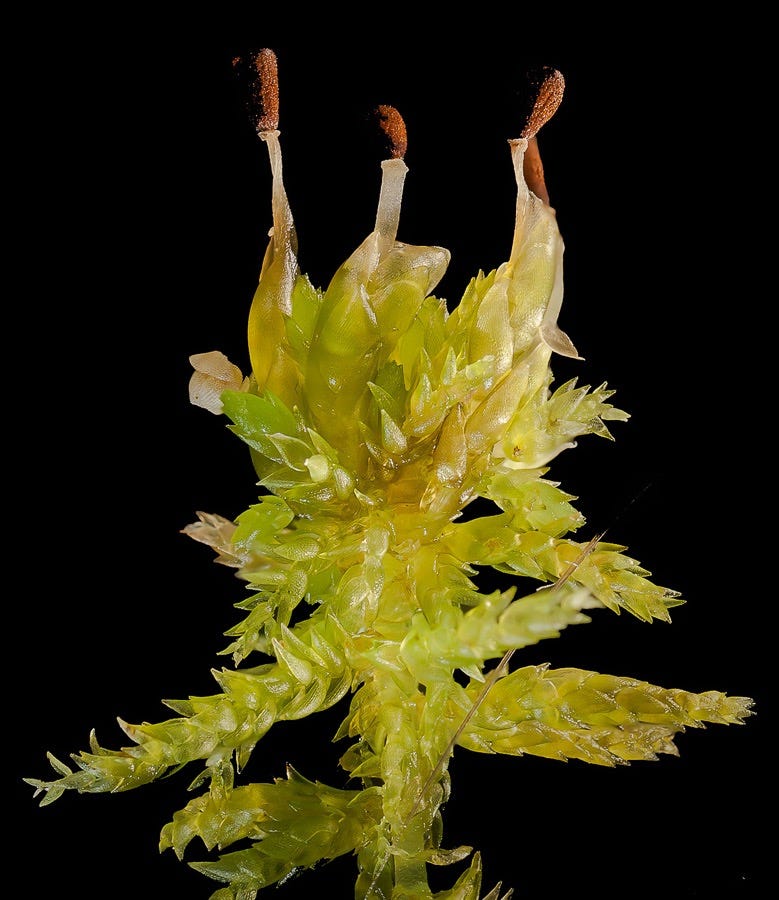
Long after giant marine insects and crustaceans developed magnificent geometries underwater; long after oceanic plant life greened the seas, bacteria started holding onto rocks. Incrementally, that life creeping over an inert land, became moss. It dragged water up in its haul, bringing, like the tail of a slug, a chemical breakdown that soon made soil and oxygen. The moss lingering on the Church Avenue subway entrance cement is almost the same kind of moss that found its way to land. It hasn’t seen the need for evolution in all that time. The strongest things in our world are tiny, soft, and so yielding they can work in their sleep. They work even when they’re dead and yet they are creative beings, able to make ecosystems wherever they go.
The Small God
If delicate peatmoss is not golden at the top, it’s a rusty orange. They always glow green underneath, though. Some say, if they look through a lens, the two leaves at the top look like a minuscule bird’s beak. Capsules full of sporophytes sit like golden eggs in the tiny lush mess of the capitulum - the top of the moss. Delicate peatmoss is one of the nearly 380 species in the Sphagnum family, so it’s shaggy. The mass of scalelike leaves whorl around sidelong branches before they dive into the earth. This long delicate peatmoss branch can be about 13’, thwarting every expectation for mosses being very short in stature. These branches act as threads in their ecosystems. As the tower of leaves descends, the side branches curl in like claws, using the physics of water to cling to itself and pump up.
Unlike ferns, delicate peatmoss have a mess of rhizoids at their bases, instead of true roots. Moss are older than ferns, but the two evolved before flowers. They reproduce with spores, a haploid gametophyte, smooth mini moss mixing with a spore carried by water. Because they rely so much on water, mosses must take responsibility for the moisture around them.
While their branches act as the warp to the water’s weft, a microscope shows how delicate peatmoss fibers look like lace holding water in. These are called hyaline cells, which are a transparent membrane that fills up like a balloon. When it’s plump the delicate peat moss stands straight. The leaves are barely big enough to see with the human eye, though each individually weaves the water into a tight tapestry. Each plant can hold twenty times its weight in water.
As the name suggests delicate peatmoss is small, even for a bryophyte, and certainly delicate. The plant is barely there: one cell thick that breathes in water, that summons air to it so that the gust can linger and be persuaded to lose its water. The outer cells are alive. But delicate peat moss works with its own death. Dead cells plait the interior of the plant ensuring a bog is a bog. The dead are so very fundamental to this place. Like any place. But a bog is almost entirely not alive.
On a peatland, only the top of the moss lives, like warm sentinel to the underworld, most of the plant, even as the water rises through it, is dead.
Everything about delicate peatmoss hangs at the balance of presence and absence, between life and death, emptiness and fullness. Nina Petek illustrates the apparently contradictory Sanskrit term considered in Buddhism: “śūnyatā, derived from the Sanskrit verb root śvi-, meaning “to grow”, “to increase”, “to swell”. This meaning is further deepened by the suffix -tā, which in Sanskrit denotes totality, illustrating the nature of emptiness, which is not empty but overflowing with an immeasurable, unfathomable abundance of being.” Delicate peatmoss, both full and empty, is also creative, like all mosses.

The Living Dead
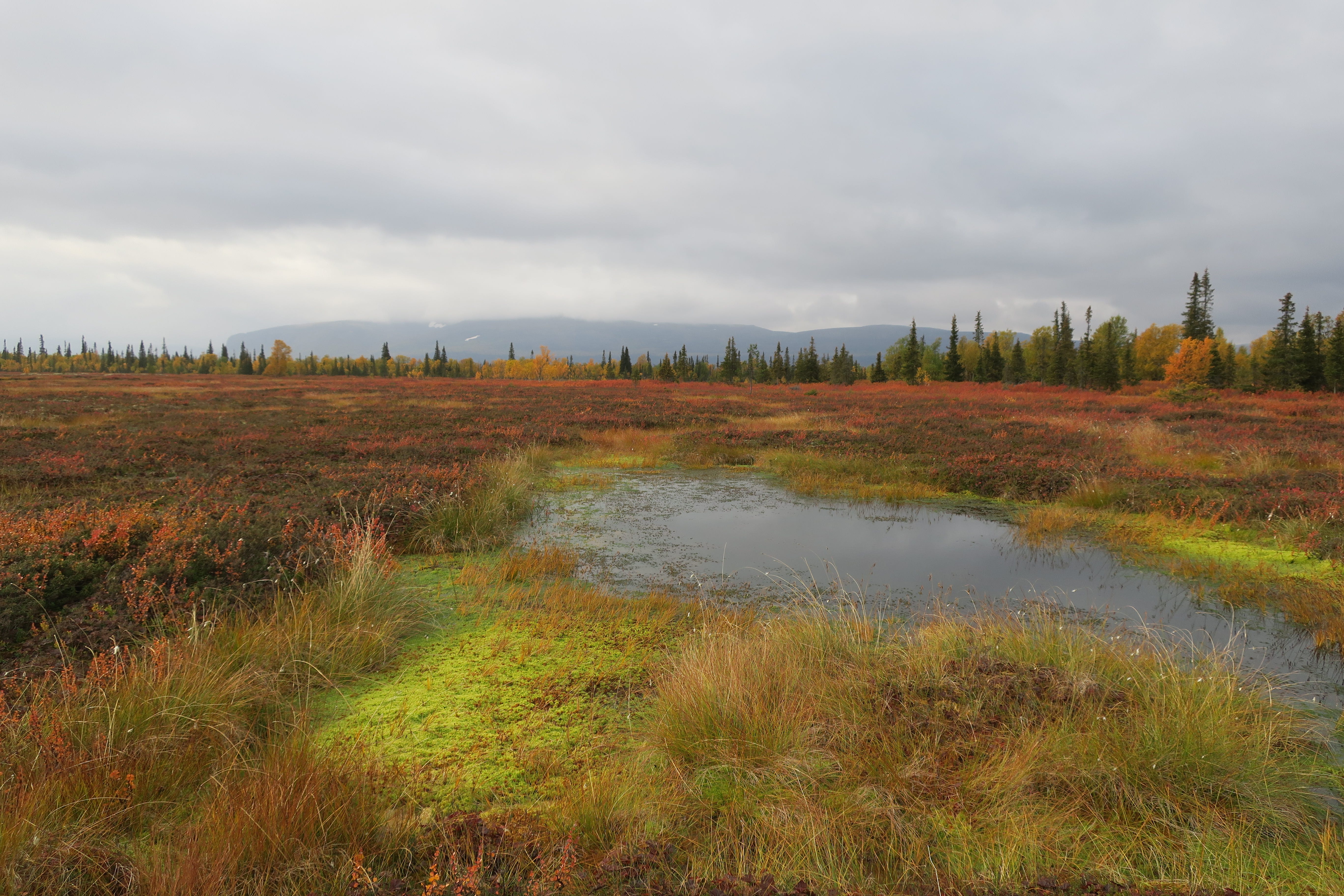
In the same way sand might make a desert or oak a hardwood forest, Sphagnum makes peatland. It works in hydraulics, both as architect and one of the sole inhabitants on a tightly woven ecosystem. The individuals of this species create one of the most valuable places on earth. Peatland is a densely compact wetland that looks like it should be solid, but it is an inundated sponge. Many plants have difficulty growing here because the soil is so acidic. As a result, it is open to the sky, and slightly curved upwards.
Cyanobacteria live inside Sphagnum and fixes nitrogen, making what little nourishment the bog has as the nutrient cycle is so profoundly suppressed. Plants like sundew live in peatland. Eating flies, they also play an important role to bring nutrients into a soil, nearly empty of nitrogen or oxygen. Peat is slowly decomposing organic matter: dead animals and plants and fallen leaves, that have accumulated over thousands of years build and build. The peatland begins at the base of groundwater or a spring, but over time the ecosystem will grow through peat and create the shape of a dome, lifting from all ground water, relying only on rainfall to sustain itself. This is when it becomes a bog. A fen, by contrast, is fed by water on or below the ground. Both bogs and fens are the work of Sphagnum.
Delicate peatmoss has been traveling on land for millions of years - 450 million or so, to be exact. At the moment, it is a creator of the bogs, prevalent in the Pskov and Leningrad regions, Karelia, Murmansk and Arkhangelsk regions, primarily hugging the northern ocean in the western fold of Russia, though peatlands exist in every continent.
The bog is like a library, archiving everything that has come through them: creatures that have died on them, lost toys, teeth, a letter.
It’s no mistake that bogs are haunted places. You taste it in the murk of scotch whisky which is made of Scottish peat. In Ireland they’re thin places between the living and the dead. Moss makes their bases black. The color of richness: humic and tannic acid seeps from them, steeping into a dark water. Leprosy can live in peatland in the form of Mycobacterium leprae DNA, a disease that literally breaks the body down with shadowy moldering.
Robin Wall Kimmerer has written broadly on the beauty of mosses. “There is more living carbon in Sphagnum moss” she writes, “than any other single genus on the planet.” It’s hard to imagine the carbon in the air: we imagine pollution as something akin to smog, and there is some truth to that, but climate change is also invisible. Under the peatland is a mass of carbon. For this reason they are dug up and used for agriculture. It’s very possible that the last tomato you ate was nourished by peat. Peatlands take in twice as much emissions as all forests on the planet, despite covering only three percent of the earth’s surface.
Sure, your hand may sink into the bog. Your gait may waver as the moss bends below your weight. You may look down upon the moss, able to tear them without more muscle than it takes to write your name. But delicate peatmoss is not so precious. It has eaten the carbon of one thousand plane trips and more.
Sickness and Health
Moss are emblems of passive self assertion. They reflect the world around them. They are supremely vulnerable. And within that comes their strength. Everywhere you go - every day of your life - you will never be far from a moss. It’s not a punishment. It’s kind of a witnessing. They were sitting outside of the window when you were born. They are close to you when you cry or become who you were always meant to be.
Though mosses make themselves undesirable as food, deer may nibble on the tiny plants, all crammed together. Birds weave with moss, not only for warmth, but antibacterial protection. Sphagnum species were used in World War I as bandages. They have antibacterial and wound healing properties for humans too. But careful with the peatland, it has its dangerous mythology for a reason.
Cut down or broken open, the carbon held within bogs, or sequestered in trees, reemerges like an unhappy spirit. When peatlands are torn up they emit methane gas. Currently, destroyed and dried peatlands are making up 5% of all global emissions.
In The Oak and the Larch by Sophie Pinkham, the indigenous cosmology of many Siberian peoples states that digging in the taiga, where many peatlands are, is dangerous because it might awaken the spirits of the underworld. The more research there is about soil, the more correct this belief feels. Bogs are incredibly potent places - holding the potential for both growth and slow, terrible, decay. I like to imagine them as slow beasts, tingling from the tips of their hairs. The yellow of the mane.
Strength is made with courage and slowness, an open heart, and a vulnerable spirit. Delicate peatmoss doesn’t carry the greatest weight through deadlifts or tremendous strides, but by taking it all in, knitting it all into a place for themselves and those who came before.
myth for delicate peat moss
Text for myth, music for myth: Tchaikovsky - Symphony No. 5, Op. 64, “Allegro con anima” CC BY-NC 4.0,
Forager Friendly?!
Yeesh - I mean, yes, but keep the peatlands wet.
Sources
https://kmkjournals.com/upload/PDF/Arctoa/23/Arctoa23_070_079.pdf
https://www.mdpi.com/2073-4441/15/20/3526
https://www.britishbryologicalsociety.org.uk/wp-content/uploads/2020/12/Sphagnum-tenellum.pdf
The Oak and the Larch: A Forest History of Russian and Its Empires, Sophie Pinkham, 2026, W.W. Norton & Company
https://www.unep.org/interactive/explore-ecosystems/peatlands/en/index.php
https://nwwildflowers.com/flora/?t=Sphagnum+tenellum
https://en.wikipedia.org/wiki/Hyaline
https://pubmed.ncbi.nlm.nih.gov/40483438/
https://news.clemson.edu/on-solid-ground-sustainability-through-soil-research/
http://www.efloras.org/florataxon.aspx?flora_id=1&taxon_id=200000835
https://linnet.geog.ubc.ca/Atlas/Atlas.aspx?sciname=Sphagnum%20tenellum
https://eunis.eea.europa.eu/habitats/5077
https://www.naturespot.org/family/sphagnales
https://www.unep.org/news-and-stories/story/peatlands-store-twice-much-carbon-all-worlds-forests
https://www.slideshare.net/slideshow/russia-the-largest-peatlands-country-in-the-world/55820698
https://www.hiddenforest.co.nz/bryophytes/mosses/reproduction.htm
https://journals.uni-lj.si › article › download
https://europe.wetlands.org/peatlands-passport-a-tour-of-peatland-types/
Mosses, Liverworts, and Hornworts: A Field Guide to Common Bryophytes of the Northeast, Ralph Pope, Comstock/Cornell Paperbacks, 2016
Gathering Moss, Robin Wall Kimmerer, Oregon State University Press, 2003
https://northernforestatlas.org/atlas-images/nfa-bryos-sphagnum-tenellum-00855/
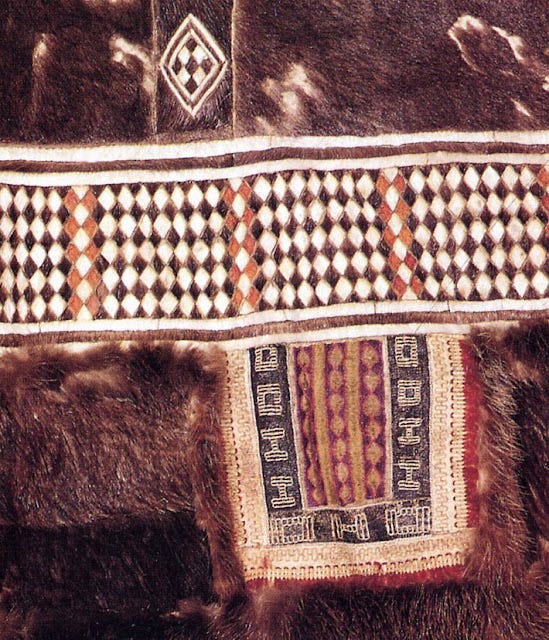
Scrapbook for delicate peatmoss…
