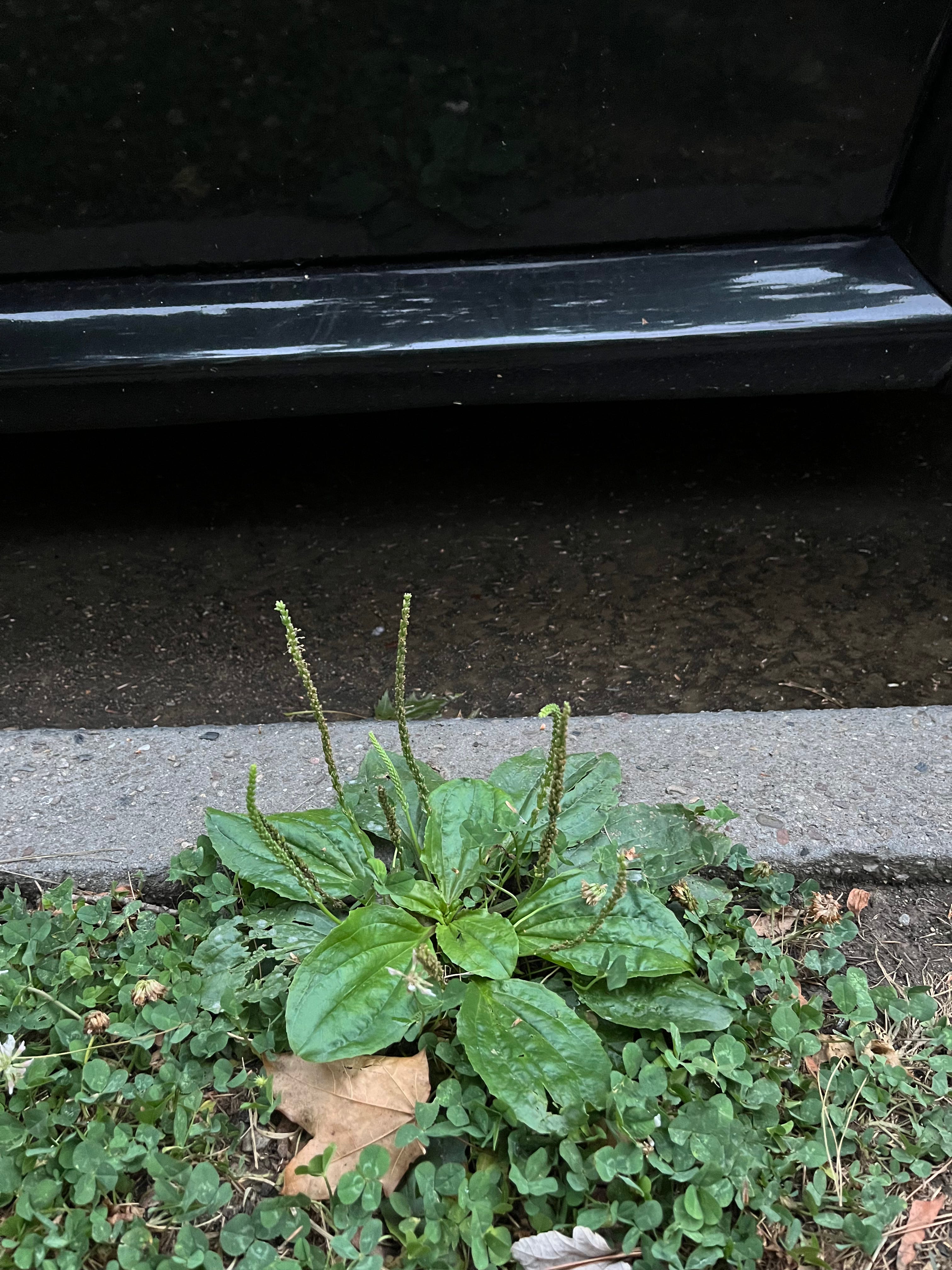
That's Broadleaf Plantain!
A protector plant. A shield

ALSO KNOWN AS: Broadleaf Plantain, Plantago major, white man’s footstep, common plantain, great plantain, greater plantain, Lesan-ol-haml (Persian), ribgrass, waybread, cart-track plant
How to know
A spike inflorescence
Egg shaped leaves that are striped with veins
These leaves lay flat to the ground
Flowers so small they look like power
A Weed Who Knows Roads
This is far from the sweet plantain so familiar in Caribbean and South American cooking. I don’t want to make our mouths water. So I will call this Plantago major, a simple weed that is, in many ways, as strong as a rock. This is one of the footpaths and desire trails, places where people cut across meadows and, over time, gently pushed grasses apart. This plant is named after those footsteps. Plantar is latin for sole and is this plant’s namesake, as if it echos the footfall.
It looks like it's slightly flattened by the feet of travelers.
Plantago major is one of 200 species of plantain that span the globe and threads itself into the lives of humans in similar uses throughout time. Plantago major is native throughout Europe, to Asia and down into all of Iran. For about four thousand years, if not more, Plantago major has thrived beside humans. It appears that Plantago major came to the Americas with the start of colonization in the 1600’s. The plant so consistently heralded the presence of white settlers that the Anishinaabe called it whiteman’s footstep. The plant’s sticky seeds must have grasped to the leather boots. However, unlike many plants it does not act aggressively and destroy ecosystems as it goes. No, it has naturalized, it was adopted by many indigenous peoples who saw it for its medicinal properties.
Plantago major grows in compact and disturbed soil alike and can survive in so many different kinds of sun situations, it’s not worth listing. Give it packed down clay and loam, even some sand, and it will sprout enthusiastically. It prefers the sun, but it does its work wherever it can. While many Plantago plants share a spike of inflorescence above smooth leaves, which are often rounded and grow in a rosette close to the ground, they don’t grow taller than the rare one foot high. It’s easy to miss.
The Plantaginacea family is vast and includes many plants in the temperate regions that band the globe. They have wide leaves and tall flower heads. Some of them are the foxgloves, snapdragons, and speedwells. Plantago major has a close relative in the narrow leaf plantain that has a similar form of basal rosette, and a tall inflorescence with tiny flowers hovering around the head.
The Plantago major is a notable one, and the one I fell in love with as a child. I learned about Plantago major and dandelion in the same breath and promptly thought that they were both the same plant, simply because they grew next to one another:
The lion next to the hippo, the goldfinch next to the mourning dove. Compared to the glory of the dandelion, Plantago is deep, quiet, and powerful.
For all of the valuable pharmeceutical qualities the dandelion has, Plantago major has more. Though it hides in green obscurity, it has very specific values that make it stand apart from the rest of plants. The plant is rich in vitamin A, C, and K. calcium runs through the plant, along with potassium. It is proven to be antibacterial, an antihistamine, antimicrobial, anti-toxic, often used on snake bites, and as a diuretic.
An Oval Shield
Many cultures hold the Plantago major as sacred for its wide variety of medicinal properties, from a breaker of fevers, to a soother of coughs, vulnerary, a word that means healing topical wounds, and a ridder warts.
The Nordic, Saxon, verse praised Plantago as one of the nine sacred herbs that protected the living against the worm who lives in the earth. In traditional Persian medicine, it is considered a cool earth medicine - this medical practice works in a similar way to Ayurvedic and traditional Chinese medicine that establishes heating and cooling properties to treat ailments or parts of the body. While all of these traditions are distinct and layered on their own, the effects of Plantago major consistently seem to cool and constrict the body and the ailment.
In more recent medical history, Johnson & Johnson used the inspiration of a plantain leaf to make the age-old band aid, which, does have the texture of a leaf. Or maybe skin is what has the texture of a leaf…
When torn, stubborn fibers from the parallel veins will string against the hands. These plants are known for their leaves’ distinctive grooves, or leaf venations, which look like stripes. But in reality, inconspicuous veins line the interior of the leaves. Shaped like tiny shields to the earth, these leaves are the main source of remedy. To release the chemicals in the plant, the leaves are generally chewed and placed on wounds.
Plantago is medicinal first and edible second. The plant has some oxalates in it, so while it's always edible, it is bitter as all hell. It may taste better when it’s younger, before it bolts into flower. But never is it sweet. It always is a little hard. In this way it’s kind of grounding. The tannins that create its hard astringency pull skin together. When it does bolt, the seeds have been used as medicine, and can also be collected and prepared like grains of rice or ground into flour. The seed capsules that dot the fibrous raceme (stem) can hold thirty seeds each. Sometimes Plantago major has up to 15,000 seeds in all, some of which can stay dormant for sixty years.
The flower to the human eye looks like nothing but a wand driving up into the air and dusted with flowers so small they look like specks of sun. But insects love them. Bees are known to pollinate them, as well as wind, but they are an essential plant for the buckeye butterfly. Perhaps the buckeye butterfly, a native to North America, saw the Plantago major and knew it immediately for what it was, like a flickering torch in a deep night, and a protective food for its young caterpillars. The buckeye searches, ready to alight, with round-eyed wings, on this new subtle beacon.
Myth for Plantago major
Forager Friendly?
Yes, yes, just make sure you are harvesting these plants at least 50 feet away from regular traffic and away from rail roads to protect from the chemicals that get absorbed into them.
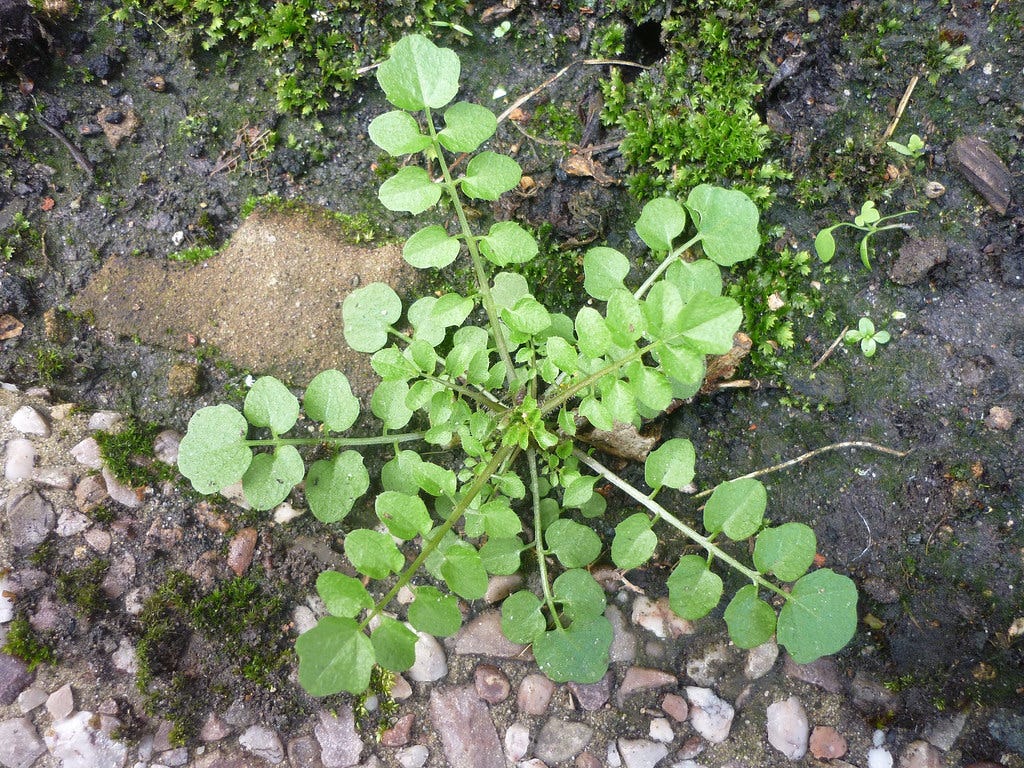
Not to be confused with bittercress. They have a similar basal rosette form, but these leaves have undulating lobes down to their base.
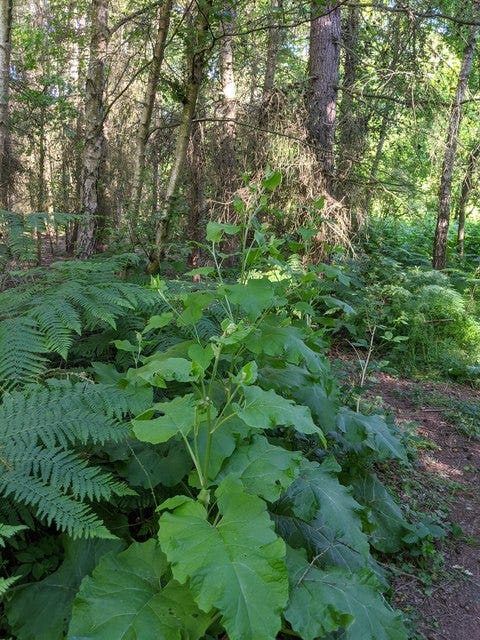
Or burdock. I love burdock. Its leaves are also like leather and they grow in a similar basal pattern, but burdock leaves can grow huge and the stems can grow many feet high.
Sources:
https://ifnaturecouldtalk.com/weeds-for-butterflies-and-more-on-our-native-pollinators
https://ipm.ucanr.edu/PMG/WEEDS/broadleaf_plantain.html
https://michiganflora.net/genus/Plantago
https://nph.onlinelibrary.wiley.com/doi/10.1111/nph.12253
https://celticearthspirit.co.uk/the-humble-persistent-little-weed-plantain/
https://www.pullupyourplants.com/archive/plantago
https://awkwardbotany.com/2015/05/13/ethnobotany-white-mans-foot/
https://extension.wvu.edu/lawn-gardening-pests/news/2020/07/22/broadleaf-plantain-weed-of-the-week
Wall-Kimmerer, Robin, Braiding Sweetgrass
https://herbasvet.com/en/medicinal-plants/broadleaf-plantain-plantago-major/
https://www.butterfliesandmoths.org/species/Junonia-coenia
https://en.wikipedia.org/wiki/Plantaginaceae