
That's Bloodroot!
A stain that lasts

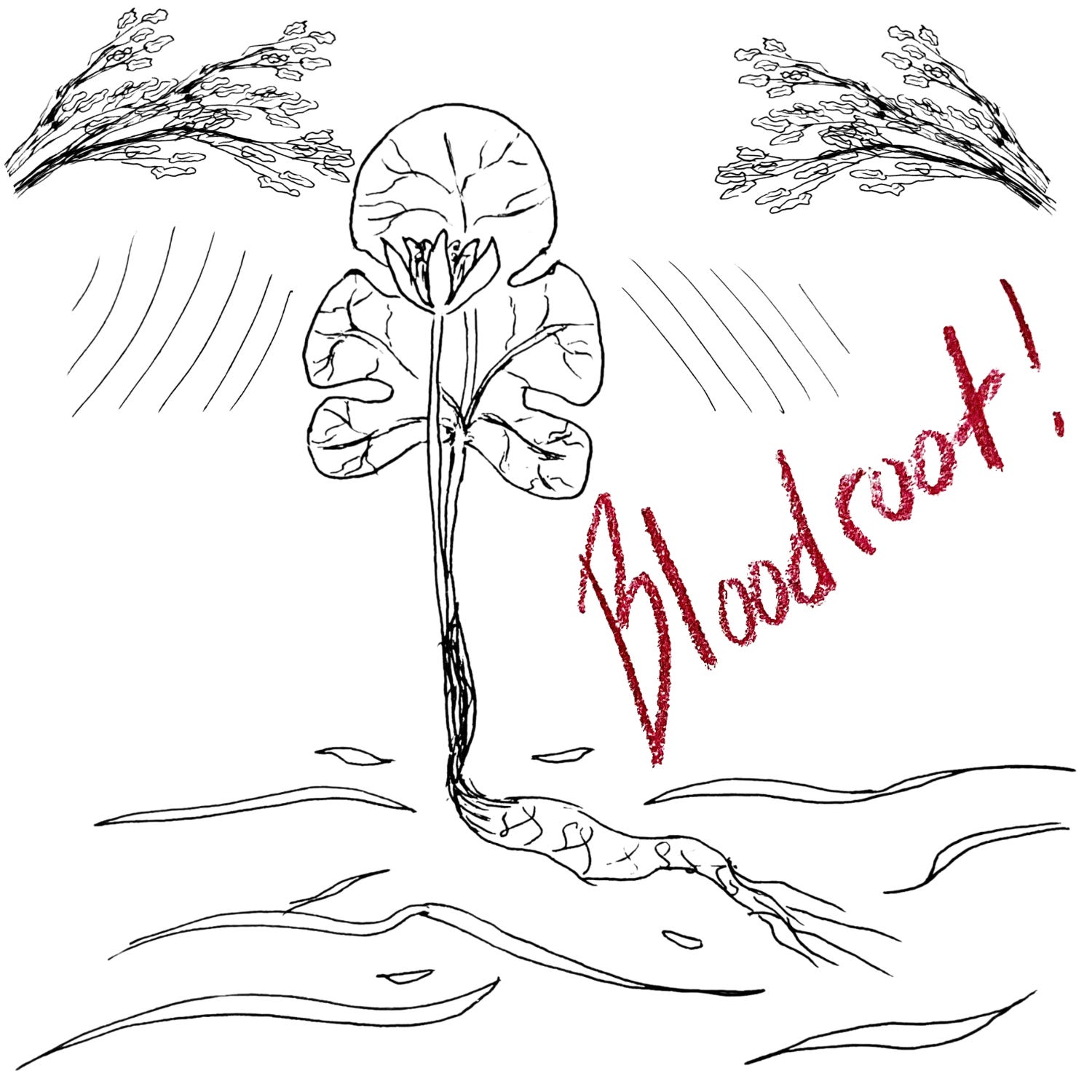
ALSO KNOWN AS: Puccoon, Red Puccoon, Indian Paint, Redroot, Pauson, Tetterwort, Sanguinaria canadensis
Most of the New England forests are second or third growth, since European colonists created pastures. But at one point they must have looked quite different. I’ve heard there are ancient hardwood forests in Massachusetts and down in North Carolina, and though I’ve never been, I imagine they are both lighter and darker than the forests we know now, tall trees, I guess, and light coming through. I can’t help but think of a cathedral, with underbrush and dramatic trunks with generous space between. In the hardwood forests of New England, a little plant marked in red finds home. Nathaniel Hawthorn might have imagined Hester Prynne with her scarlet letter finding freedom in an old forest like this. A small white flower in the dark woods filled with a red blood. This is a plant in the shadows of forests. The most terrified I have ever been is in the woods and also the most at home. And it is in this juxtaposition between hair raising terror and overwhelming awe where gods live. Each forest has a story to tell and bloodroot is an expression from old one. The puritans cut themselves off from everything, Hawthorne insists. They also cut trees down and down so the northeast is more forested now than it was then. And yet something is alive in there and it works in blood.
Blooms in the Old Forest
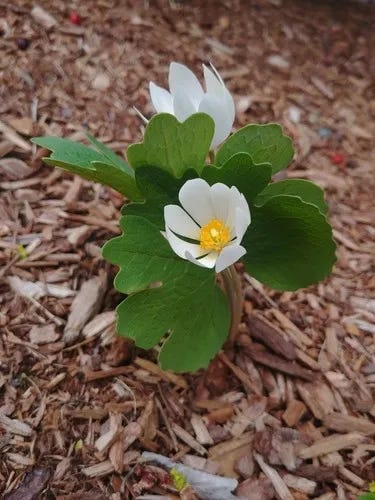
From 4” to 6” off the ground, bloodroot begins and ends with a single leaf. With the drama of some proud, hooded vampire, a match shaped shoot rises out of a wrapped leaf that in turn unfurls to reveal a paper white flower that blooms with a collection of golden stamens at its center.
Bloodroot is an expert at counting daylight hours the entire winter and finds the time is right when sun pours through the newest leaves of an early April in the spring. There where the dull shadows cover the ground, it emerges. The flower only appears from one to three days, closing in the dark. They don’t produce nectar but protein filled pollen that brings sweat flies and mining bees. If three days have passed and it has not been pollinated the stamen will bow and pollinate the pistil.
The leaf is almost fleshy to the touch. It has between five and nine soft lobes. At first glance it looks a bit like a sand dollar. Every flower has this single leaf: light green, and on the backside grey, hairy, and lined with orange veins.
While it belongs to the legendary family of poppies, the Papavercea family, there is no other plant in this genus. There is no other bloodroot. Only this one. As part of the poppy family it has active poisonous alkaloids, but like poppy, it has useful medicinal qualities, if extracted and applied correctly. Like many poppies it has that distinctive sap - that is white in poppies and red in bloodroot. But it can be orange or yellow in other plants. Either way, there is something about this latex sap that feels eerily alive. Many plants have clear sap that looks watery, or ever slightly more viscous than water. But this latex comes out like some strange mixup has happened. It bleeds. Like animals, like us. Except when the iron oxidizes it turns black. The sap, over time, turns black.
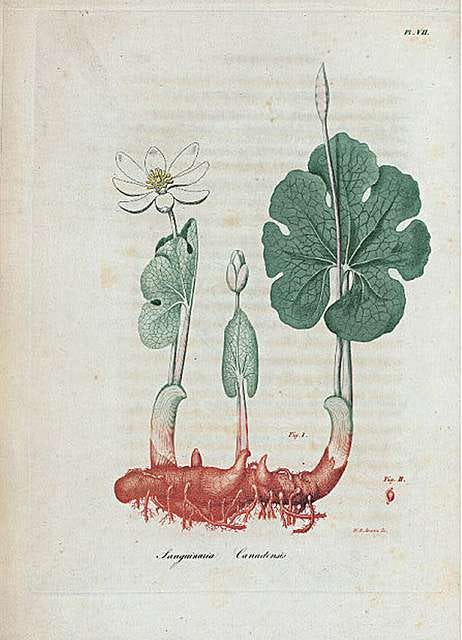
They are indicators for soil that has not been disturbed in many years because of how long they take to develop. Bloodroot does not rely on seeds to propagate. They crawl slowly along in the floodplains, hardwood and wooded outcrops. Their tuberous, rhizomatic roots clinging to the soil. They can take years to grow. When planted they can take three years to flower, and even longer to expand into a small community of bloodroot on the forest floor. These roots are their namesake: unsurprisingly, deep red underground, cut that thick root open and it looks a bit like a golden beet, dripping red making a yellow or orange dye. Like potatoes, these rhizomes have eyes, and they’ll bloom again from them.
Moisture is what keeps this plant alive. As it is with hardwood forests, bloodroot needs that acid made by oxygenated rotting leaves. But it can grow in sandy loams as well. The more moist the soil, the longer the leaves live. The reason why you probably can’t buy bloodroot seeds is because they need to be wet. So the little round seeds produce a fat mixture allowing them moisture at least until they begin germinating.
This substance also congeals into a sweet fat lip. Many spring ephemerals supply an eliasiome, a fatty, sugary treat. The natural world understands how to make life fun and delicious. The spring ephemerals make an ice cream for ants like the first ice cream truck of the season. How we are like ants to ice cream trucks. They pick the seeds up with their little canny bodies and bring them back to their nests to eat. Bless ants for being the first to build the forest each spring. They’ll bury the seed in their ant transfer stations where the seed will germinate. Ants and fatty seeds is called myrmecochory.
An Unlikely Medicine
Bloodroot is a colonist’s name. The Powhatan word poughkone or pohcoons refers to its cultural use meaning “red paint,” the very same redness that covers the plant. They have been used as dye and as body paint.
The poppy family is, obviously, an economic boon throughout the world. They fringe the desert, but never the tropics. Bloodroot is certainly not edible, and the medicinal qualities of the plant are a contentious subject, however it is experiencing over harvesting throughout the Northeastern woodlands. The roots are bundled and sent to Europe to put in animal food because cows have been given too many antibiotics to have their effects. Bloodroot works. It protects against worms and other livestock illnesses. This is still not commonly used in the United States - which is why they’re being sent to Europe.
Besides being used to keep livestock healthy it can also be used as an insecticide. But the medicinal properties to humans are complicated. It has been used medicinally to treat skin conditions and respiratory infections. It has chelerythrine, which is a powerful medicinal, and toxic, compound that has antibacterial, and potential anti cancerous properties. It also has berberine, which can be used in metabolic health. There is also Sanguinarine, which is an antiseptic and anti-inflammatory, but it is also toxic. There has been an influx of videos that state the best ways to use bloodroot on one’s skin but the concoctions, the compounds are dangerous. This is the popular surge for the home made “black salve.” Dark marks that look a bit like mud growths grow from the skin where the salve is applied. The salve opened a man’s skin, and lesions expanded. It was a kind of eating, ulcerating and growing in what I can only describe as zombie-like wounds. There are many accounts of this. An emergency room visit proved one person had malignant melanoma as a result. There are terrible stories about putrid boils. It can burn tissue if there is too much on the flesh. As a medicine it has been used to treat coughs and skin conditions by indigenous communities for a thousands of years. It’s been used for toothpaste and anti plaque. But the medicinal benefits of the plant has been skewed.
A Red Stain
Some gothic corner of me remembers what it felt like to sing Leona Lewis, “you cut me open and I keep bleeding.” Cathartic is not a word that comes from blood, but blood has been associated with cleansing for thousands of years in medicine. Anyone who has a period knows the release. Blood is vulnerable, open. Red might be a secret told. It might be an accident or a purposeful statement. Either way, to bleed is to know that you’re open.
Nathaniel Hawthorne wrote The Scarlet Letter in 1850, about 15 years before emancipation. There are articles speculating about the connection with race. Likely Hawthorne did not intend for race to be connected with this person, though I am only a lover of plants and not a scholar of The Scarlet Letter. But in The Scarlet Letter the Black Man is a being of the forest - a satanic creature who in and of themselves represents a symbol of oppression. In this quote, Pearl asks her mother, Hester, if she has ever met this shadowy man.
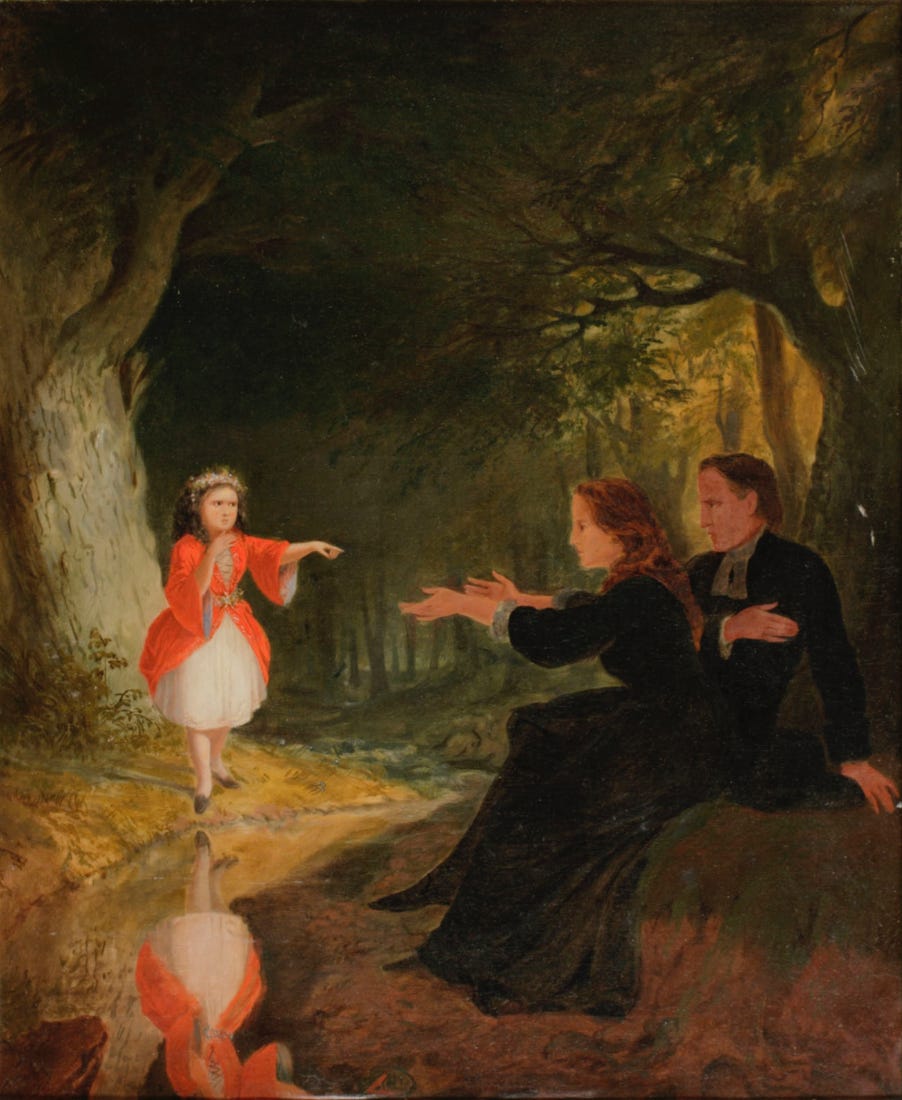
“O, a story about the Black Man,” answered Pearl, taking hold of her mother’s gown, and looking up, half earnestly, half mischievously, into her face. “How he haunts this forest, and carries a book with him,—a big, heavy book, with iron clasps; and how this ugly Black Man offers his book and an iron pen to everybody that meets him here among the trees; and they are to write their names with their own blood. And then he sets his mark on their bosoms! Didst thou ever meet the Black Man, mother?”
Of course, Hester met with the forest. Forest comes from old Germanic that is connected to the word “foreign.” And yet, the forest has given our species so much. It is a home for so many. She finds solace there. Truth. The heavy book might be a kind of fate. They may be societies rules when we have strayed, or they may be our own shadows.
I have found that a red mark from the redness of bloodroot was passed from the hand of a suitor to their intended by the Algonquin peoples. I am not certain about this story. But I feel the promise in it. Whatever shadows we have, we will meet them, like the companions of our lives. You can count on that.
myth for bloodroot
Text for myth, music: Ravel, “Miroirs No. 1” Recorded, produced, and published by: Gregor Quendel The arrangements are based on the midi notes by: Bernd Krueger (www.piano-midi.de), CC BY-SA 4.0, © 2025 CLASSICALS.DE EXCLUSIVE RECORDINGS
Forager friendly?
Nope! Not unless you really really really know what you’re doing and please don’t trust any of my musings about it.
Sources
https://www.native-languages.org/legends-bloodroot.htm
https://gnps.org/plant/bloodroot-sanguinaria-canadensis/
Plant Sluts Podcast
https://muse.jhu.edu/verify?url=%2Farticle%2F861399&r=261156
Herbarium of the Bizarre Podcast
https://www.sciencedirect.com/science/article/abs/pii/S0378112717305911
https://www.nps.gov/shen/learn/nature/wf_bloodroot.htm
https://www.srs.fs.usda.gov/pubs/gtr/gtr_srs086.pdf
https://www.natureinstitute.org/article/craig-holdrege/meeting-bloodroot
From the Hudson to the Taconics: An Ecological Guide to the Habitats of Columbia County N.Y.
https://www.nybg.org/blogs/plant-talk/2013/04/science/bloodroot-an-understandable-misnomer/
https://nativeamericancultureblog.wordpress.com/2016/01/14/native-american-culture-flowers/
https://content.ces.ncsu.edu/bloodroot-sanguinaria-canadensis-l
https://pubmed.ncbi.nlm.nih.gov/33128472/
https://pubmed.ncbi.nlm.nih.gov/20932193/
https://www.britannica.com/plant/Papaveraceae
https://education.nationalgeographic.org/resource/antibiotic-resistance-beefing/
https://www.gutenberg.org/cache/epub/25344/pg25344-images.html
Scrapbook for bloodroot…
