
REPOT! That's Pineapple!
Two years ago this Friday

We’re closing in on 150 unique plants in the What’s That Plant?! ecosystem! To celebrate, throughout the summer (and possibly moving forward when I feel the time is right) I will REPOT some plants you might have missed.
As it is when we repot plants, these pieces will have changed slightly. There is always something new to learn about every plant. Even the smallest ones.
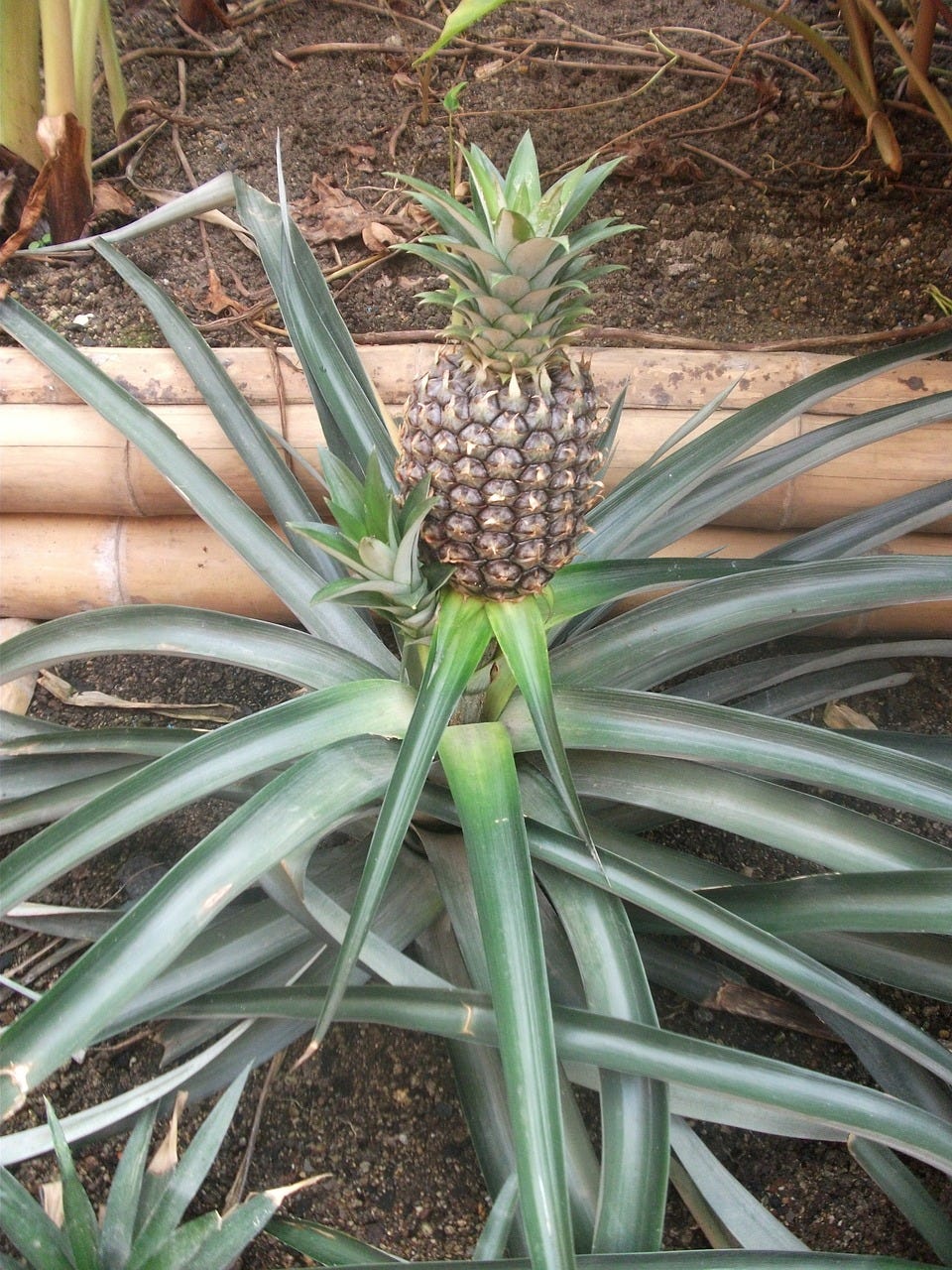
Pineapple is more than a remnant of fruit salad buffets, or a sugary memory in the back of the throat with a touch of rum after a sun soaked day. Pineapple has a long, beautiful history, with some very sinister lows. The beach of a drink that is piña colada is a dim memory of the fermented pineapple’s use as a medicine by the Carib and other indigenous peoples who used the fruit for food, medicine, and textile. It is named nanas, an indigenous Tupi word meaning “excellent fruit”, but this translation, extracted from westerners probably only touches the surface of a deeper meaning, something about excellence, abundance, and sweetness that are specific to the Caribbean culture that nurtured - and continues to nurture it.
On an Island in the Sun
Pineapple is native to the tropical and subtropical Americas. It is believed to be indigenous to the Paranà region in what is now Brazil. But it has been cultivated for hundreds, if not a thousand years or more among the indigenous populations on the Caribbean Islands, and has naturalized and adapted to those island climes.
The family Bromeliaceae is only about 10 million years old, young for many plants. There on the Guiana Shield in northern South America that contains 40% of the Amazon rainforest biome is where these plants first took their dramatic form: long lances, and nesting fruit. It includes about 50 genera each of which holds a host of species, all of which flourish entirely in the tropical hemisphere. Every one, that is, except for the Spanish moss, abundant in the American south.
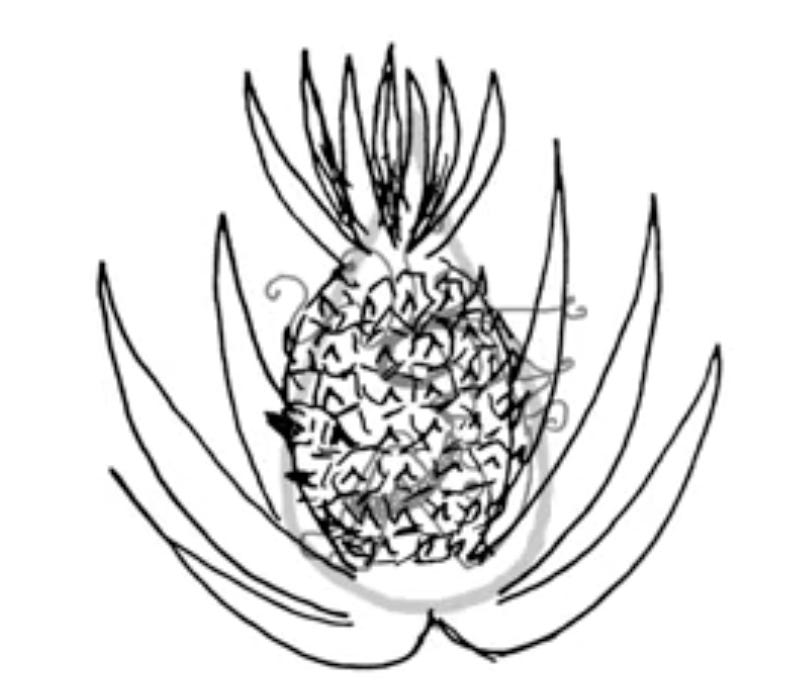
A fabergé egg. The neat 25 leaves grow in a circular nest before the fruit begins to develop like a sun in the center of a bouquet of swords. Succulent, lanced leaves grow so sharp they could cut skin. The pineapple grows 30-40 leaves at full maturity. These leaves were used by the indigenous Carib and Tupi-Guarani peoples of South America as fibers for garments, bows strings, and other textiles. There are high amounts of vitamin C, magnesium, potassium, and iron, among other minerals. It is an anti-inflammatory, and an aid in digestion. So in addition to the delicious taste, the medicinal benefits are numerous.
Pineapple also regenerates itself. New plants can grow from almost any part of itself: slips and hapas, which grow on the side of the stem, suckers, also known as ratoons, that grow at the base of the parent plant, the crown, and the stem. However formidable the pineapple appears, and resilient it is in its growth, it is particular about its location. It can’t be too wet and it is prone to sunburns. So a range of sun, dappled light, and moist but aerated soil keeps it happy. Pineapples have a shallow root system. They grow between about two and four feet tall. The well drained sandy loam soils it loves remind us of the beach habitat where it has adapted.
Many bromeliads only bloom once. A pineapple’s flower will emerge from a rosette of bracts, as a purple head all along the body of the rounded center. Once pollinated by bats and hummingbirds, the fruits will take four to five months to ripen.
Those and tiny dark seeds line the shell where the soft ovaries are. The geometrical interior of the fruit is called a sycarp, meaning they are a conglomeration of fruits all compacted into one.
Of Kings and Pineapples: A History of Violence
The brutality hidden behind the popularity of the pineapple is not far below the surface of European and American colonial opulence.
To the plantation owners of the Caribbean islands, this plant represented power in the guise of hospitality. The emblem of the pineapple was placed on entrances to buildings to show luxury and abundance. Their apparent exotic stature was also nearly mythic, so close and yet so far away from the pinecone or the artichoke. This fruit wore a crown. This image continued to the colonies in the new United States where it can still be seen at the entrance of old colonial houses from Virginia to Boston. But the sweetness is laced with the violence of the settling.
The earliest written references to pineapple are by Christopher Columbus, Gonzalo Fernández de Oviedo y Valdés, and Sir Walter Raleigh. Painters, poets, and collectors were enamored by the fruit’s simultaneous strength and sweetness. With its high concentration of vitamin C, it would sustain sailors who were susceptible to scurvy for as long as the fruit would last on ships. But the pineapple often rotted on the trip across the Atlantic Ocean making a scarcity market in Europe, which only added to its popularity there.
Europeans saw the hard tuft on its top as no less than a crown and validation for empire.
The rare pineapple that would make it to the Eurasian shore could be sold for thousands of pounds. There it struggled. Pineapple grows in 68-86 degrees, so it would always prefer the warm belt of the equator. But Europeans could not get enough of this fruit. People’s obsession was so avid that it did not take long for engineers to design expensive greenhouses with intricate warming and moistening systems which sustained and sequestered pineapples in Europe’s cool climate.
The pineapple is now all over the world as a result of colonization. Swaths of the lands eaten by plantations. It was introduced to Zimbabwe, India, the Philippines, Guam, and Hawaii through the extensive, incessant reach of empire. In the frenzy for its majestic form and sweetness, the fruit was a symbol of wealth, as a centerpiece at dining tables. At times it would be rented for an evening, not to be eaten, but to be admired. Countless adorations cascaded upon this plant, “Scaly like an Artichoke at the first view, but more like to a cone of the Pine tree, which we call a pineapple for the forme … being so sweete in smell … tasting … as if Wine, Rosewater and Sugar were mixed together.” as it is written in Theatrum botanicum an early botanical compendium. “The sweetest plant in the world.” Others lavished upon it.
Sweetness is what we seem to remember about the pineapple, but it’s actually eating you. Pineapple has the enzyme bromelian, which are tiny crystals of calcium oxalate that the plant uses for self defense and effectively breaks down the protein in your mouth. If you have eaten a lot of pineapple and felt a tingling sensation you know what it feels like to have the fruit bite back.
Look back in time to see the original, the video, and the myth
Sources
https://www.britannica.com/plant/pineapple
https://plants.ces.ncsu.edu/plants/ananas-comosus/
https://www.atlasobscura.com/articles/history-housewarming-pineapple-symbol
https://blog.library.si.edu/blog/2021/01/28/the-prickly-meanings-of-the-pineapple/
https://www.biodiversitylibrary.org/bibliography/152383#/summary
https://hort.extension.wisc.edu/articles/bromeliads/
https://minorityrights.org/communities/caribs/
https://www.self.com/story/why-pineapple-burns-your-tongue
https://www.bbc.com/news/uk-england-53432877
https://pmc.ncbi.nlm.nih.gov/articles/PMC3571438/
Find me en plein air…
I hold a botanical writing walk in Prospect Park every last weekend of the month please join me!
If you’re interested, message me on Substack or respond to any of my articles.
This month is a special collaboration with Oreades Press, for which I am a cofounder and editor.
To celebrate our newest book, Earth, an anthology that bridges scientific thought and community action, we will host a second seed bomb workshop on the June 27th from 4-5:30pm near Prospect Park. Inspired by the Green Guerillas, participants make the seed balls while sharing stories of their memories of planting through short writing prompts and story sharing. During the walk around the neighborhood where we scatter the seed balls, we also map their placement in a public app, so that anyone can go back to the spot and know what might be growing there. The event is free and open to all.